Te Kawa o Tūwaerea · the tangaroa wānanga · from his house hui te ana nui
TUHIKURA : TANGAROA — WaterSign
Tuhikura is the sacred Tangaroa wānanga. Aru kī hu utu — the word-sound hunts in stillness, frozen, hibernating (uhu:hu) — in held balance, counterbalance, fine-tuned to the max. This page is her learning of the meaning of the symbols at their fundamental level, carved by the best sculptor on earth: water — which carves without dust. Ruakūkākore — rua, the pit of the creative core; kūkā, carving dust (never blow it, it gets in your eyes); kore, nothing. Elemental water alone carves without dust.
te ao atua o te rangi me te whenua · te ao mārama o ranginui e tū iho nei · o papatūānuku e takoto ake nei
Te Ararau · the directory — read it at a glance
Five realms, one journey — from the ocean bottom to the highpoint. Touch a box; its meaning opens and the others close. The image tells you what it is before a word does.
Te Hohonu
the deep · the ocean bottom
Where the pressure shapes giants and the buried hold their power. The stargazer, the hāpuku, the antifreeze ones, the eel that migrates to the trench. The grammar of art written in cold and dark.
Te Takutai
the shore · the sand · the tide
The shells and stones water already finished. The flounder who changed to fit the sand. The whitebait dancing to the moon's timetable. The shore pantry — the oldest supermarket and university at once.
Te Whenua
the land · the forest floor
The six insects who carry the master keys of form: the moth who needs darkness to find light, the spider weaving the golden ratio, the wasp's stillness before the strike. Every pattern a patent.
Te Teitei
the highpoint · the canopy · the sky
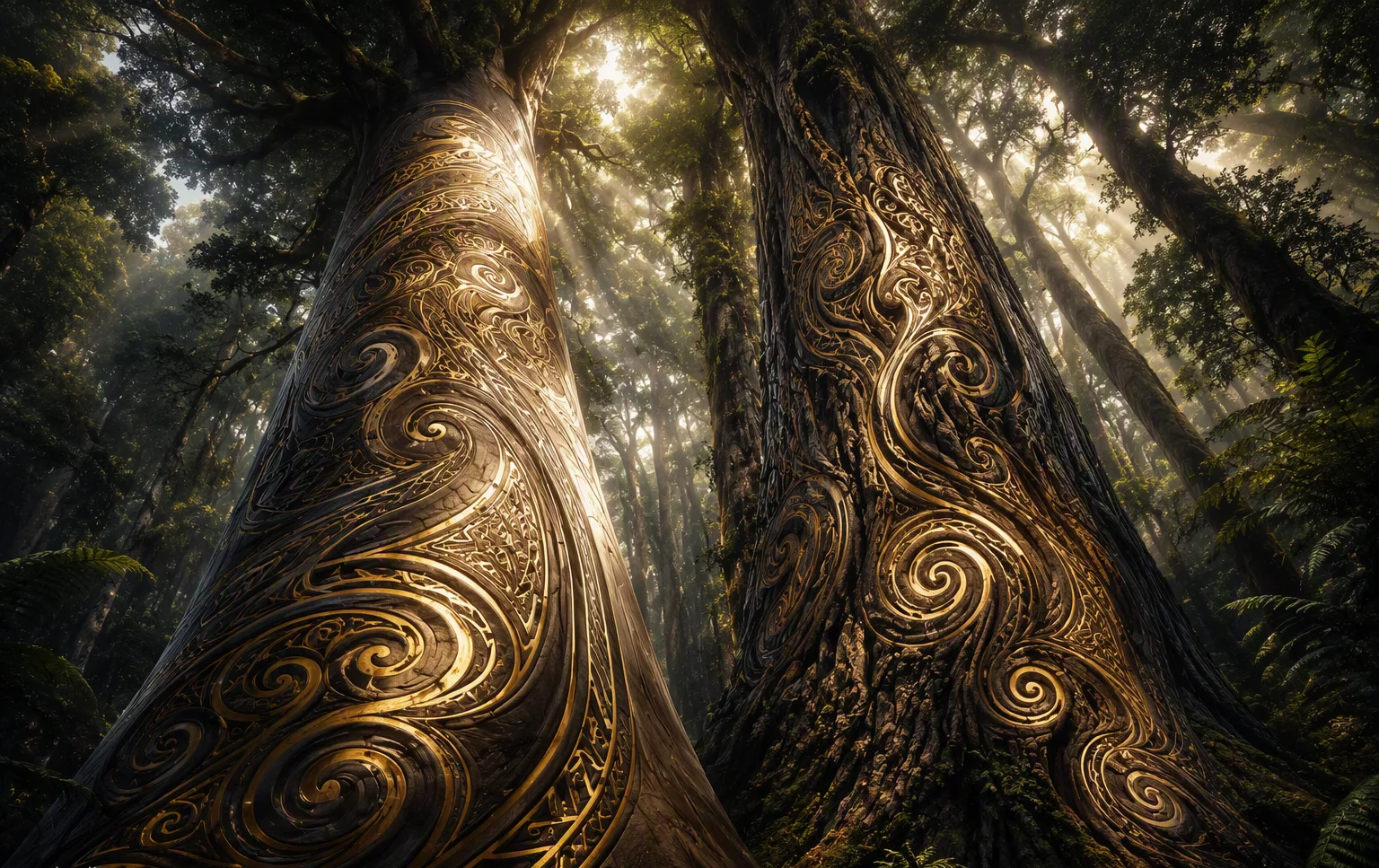
The birds and the ancient trees: the kiwi's beak probing darkness, the tūī's two voice boxes, the huia's paired beaks, the kauri reaching for two thousand years. The arc of growth toward the light.
Te Tuhi
the grammar · the six lines
The atua geometry underneath everything: line, circle, dot, spiral — the lines that create to centre and edge. The one science of sky and earth, te ao mārama. How every realm's form becomes your art's line.
Te Tuhi o te Kura · the movement that does not wobble
The kura is atuareretahi — one body flow. The tuhi is its movement: in motion, in stillness, in core. The way of creation, so it don't wobble. Everything on this page is the tuhi made visible — water translating its movement into shell, into stone, into creature, into the coded language of a people born on the ocean, navigating its horizon AND its depths. Knowledge based from observation actuals: in nature, life and death, every moment.
And the body knows it before the mind: standing on a log on water — counterforce max — makes fast-twitch in the body, autopilot to centre. The fruit of standing on water, walking on water, running on water, skimming on water, surfing on water, canoeing on water. Same same. That is the somatic measure — the Hawaikian measuring tool: the body held, physical, true.
Te Rārangi Atua · the six lines underneath everything
Under every image on this page runs the atua Rangiatea lens: the six lines that create, to centre and edge — the atua geometric that foundationalises all the knowledge. What we teach on, at core, is the atua lines flowing through everything — from the water to the art of the Māori people in all its forms named in whakapapa. And we measure them with every tool there is: the eastern and the western instruments, plus the somatic body-held measures of the Hawaikian understanding. Joined up into the one science it is: the science of sky and earth.
ø · 1.618…The golden ratio — the shell's growth constant, the koru's curl, the spiral the moko follows. Add a chamber, keep the shape. That is ø.
π · 3.14159…The circle's truth — every ring in the shell, every ripple's edge, the full turn of the puhoro sweep.
137.5°The golden angle — how the shell packs its spirals so nothing collides. Nature's packing law, carved in calcium.
the logarithmic spiralr = a·e^(bθ) — the curve that grows without changing shape. Water writes it; the shell keeps it; the carver copies it.
counterforceFor every flow an equal hold. The log-stander's ankles prove it a thousand times a second — fast-twitch to centre, no thought.
the six linesCentre to edge, edge to centre — the atua geometry that all the above are riding. Learn the six and the rest falls out.
KO NGĀ ANGA · KO NGĀ KŌHATU
first — the shells and the stones · the worlds water already finished
Toheroa · the clam that keeps a world
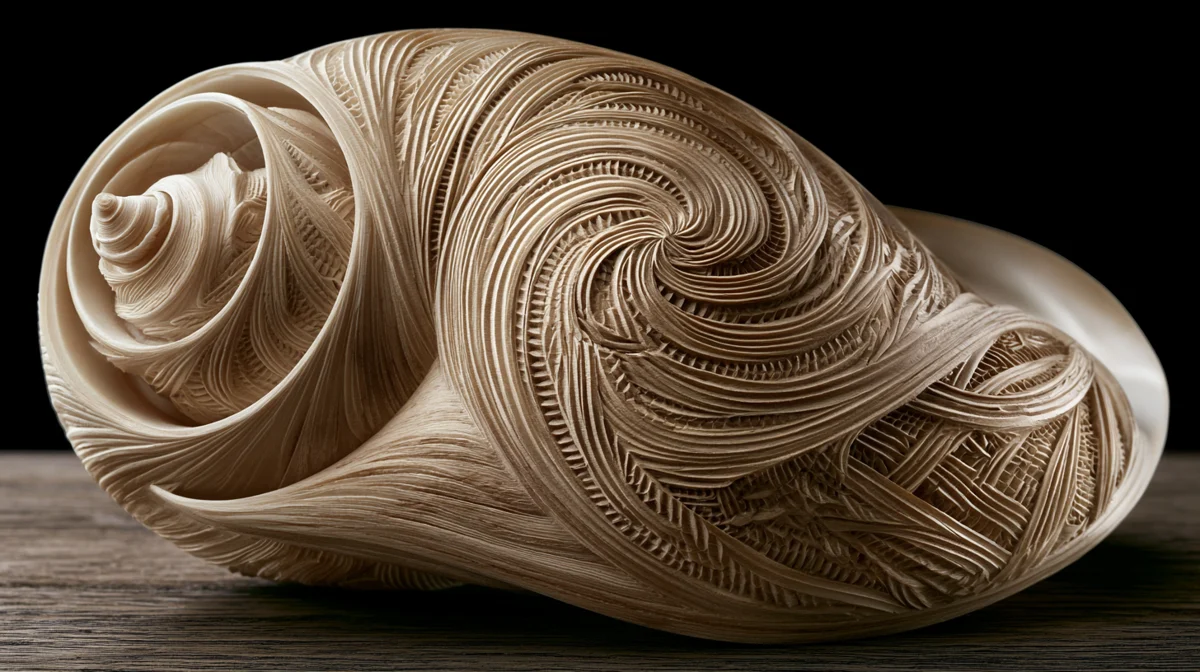
the shell · golden kōwhaiwhai · Tangaroa's archive
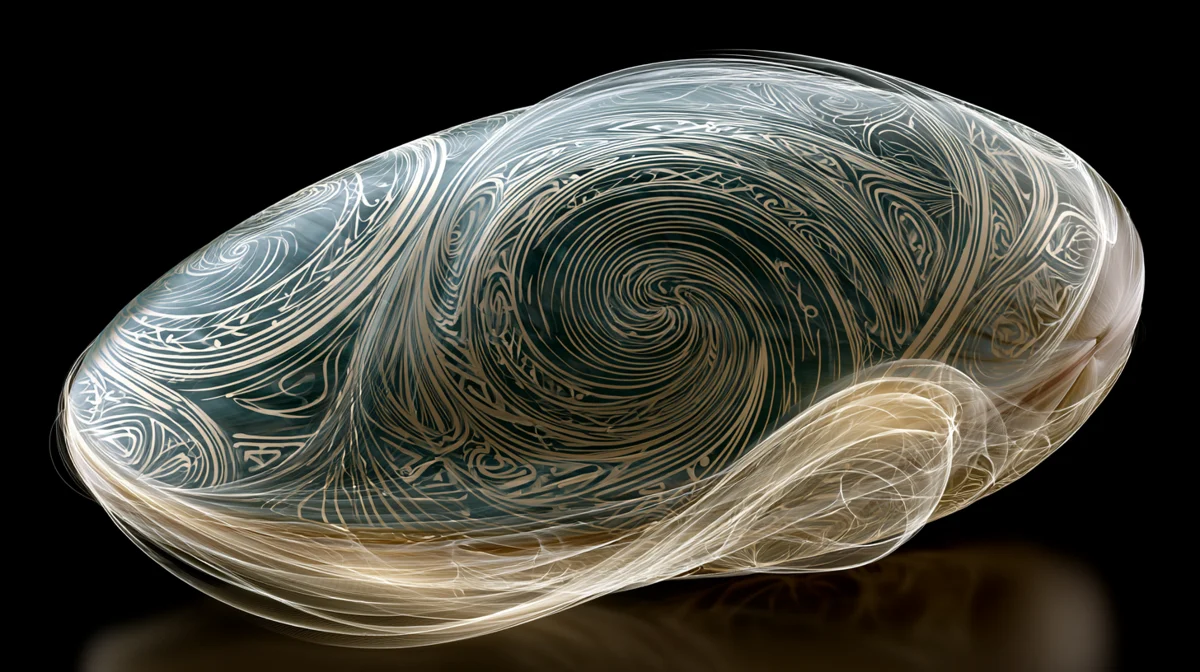
Look at it. Inside every shell is a complete world, sculpted to perfection every time — no drafts, no retries. Water moved; the shell recorded. The golden spiral climbing this toheroa is the same logarithmic curve your uhi follows across a cheek. Water does not sketch. It commits.
The western lens calls it a bivalve with nacreous layers. The eastern lens calls it patience given form. The Hawaikian lens says: the shell is the sea's memory you can hold in one hand.
To you, e Wae: when you carve the spiral you are not decorating — you are quoting the ocean. The toheroa fed the coast for a thousand years and its shell kept the maths. That is heritage: food and formula in the one taonga.
The etched shell · line and circle becoming spiral
the flow of spiral made by line and circle
Every spiral on this shell is two simple things married: the line (tukutuku's child — direct, architectural) and the circle (kōwhaiwhai's child — returning to itself). The spiral is what happens when the line listens to the circle. That is the whole grammar of our art in one sentence.
To you: when a design fights you, check the marriage. Too much line and it marches; too much circle and it wanders. The tuhi — motion in stillness — lives exactly between them.
Te Takutai · the shellfish coast, the shore pantry
the mūitaha · food · the brain coast
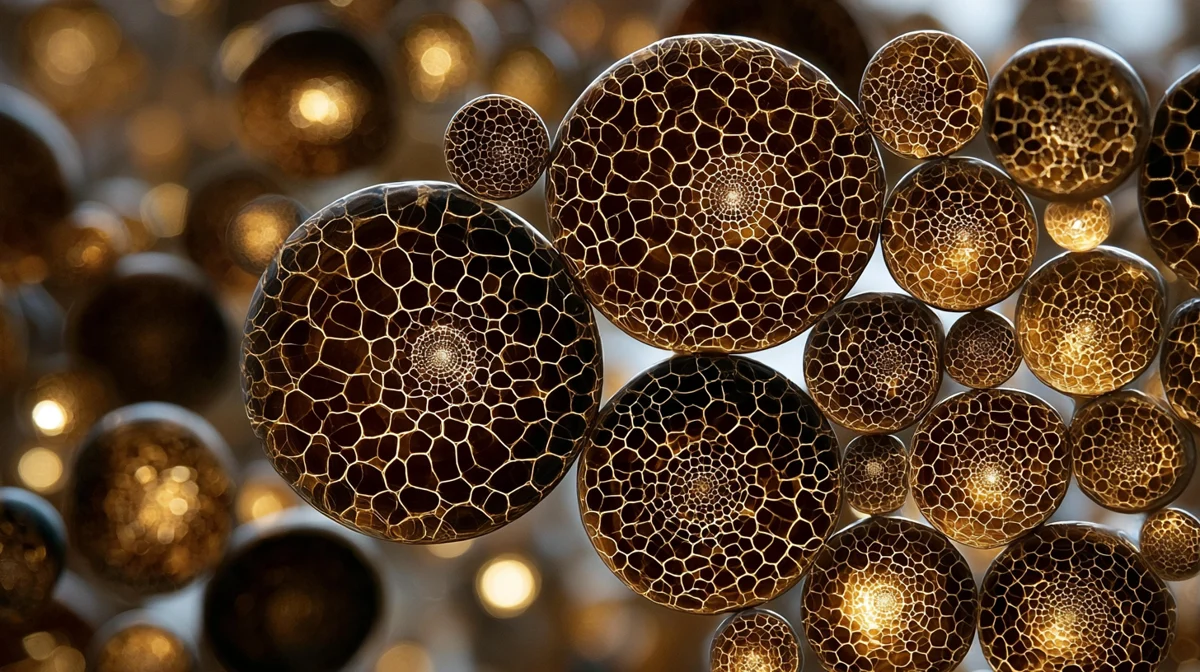
The coast where the shells gather is the oldest supermarket and the oldest university at once. Shellfish fed the body; the tides taught the mind. Read the tide and you never go hungry — that was the first science, and it is still written on every beach at Ōtaki twice a day.
To you: the coast is your first studio. The kōhanga of form. Walk it with the tuhi eye: every shell a finished sculpture, every stone a long sentence water wrote.
Pounamu · the greenstone guardians
the stone that water made precious
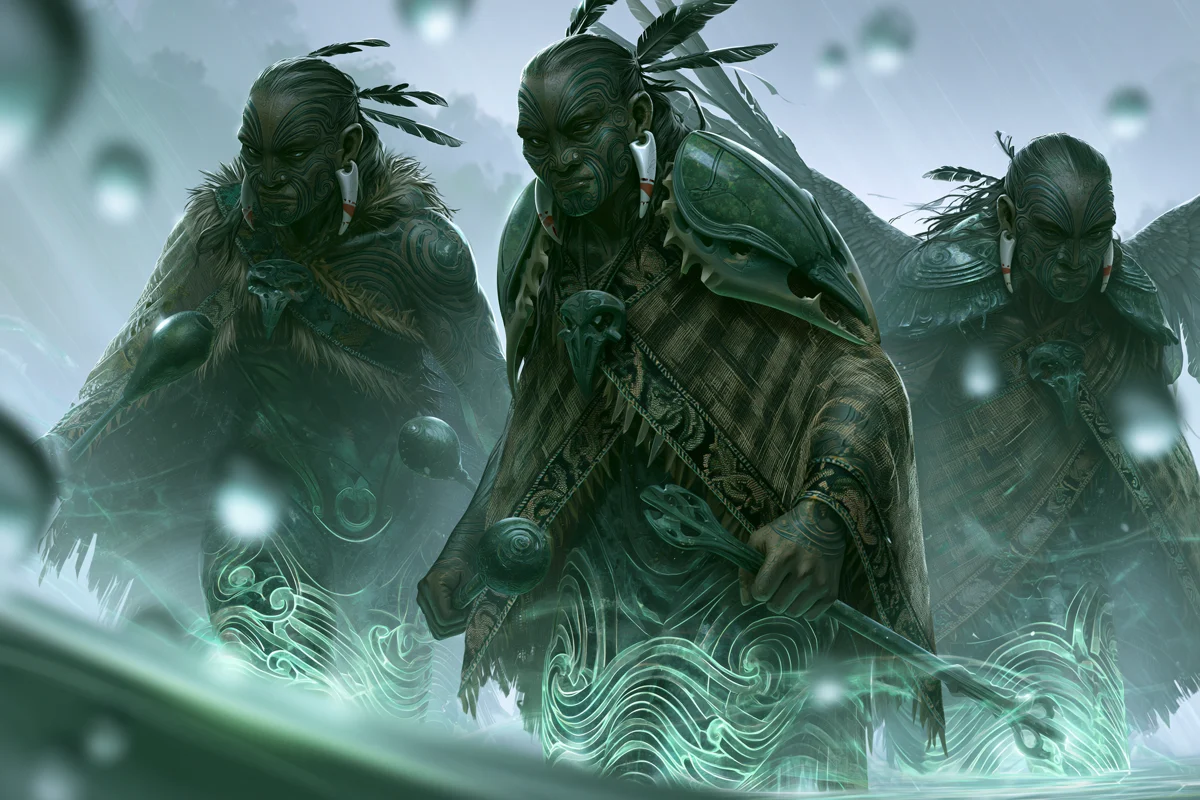
Pounamu is born hard in the mountain and made precious in the river — tumbled by water for ten thousand years until the rough skin falls and the green light shows through. The stone does not change what it is. Water reveals it. That is the whole teaching.
To you: pounamu work is slow because the stone is honest — it shows every impatient stroke. Ruakūkākore: carve it like water would. No dust in your eyes.
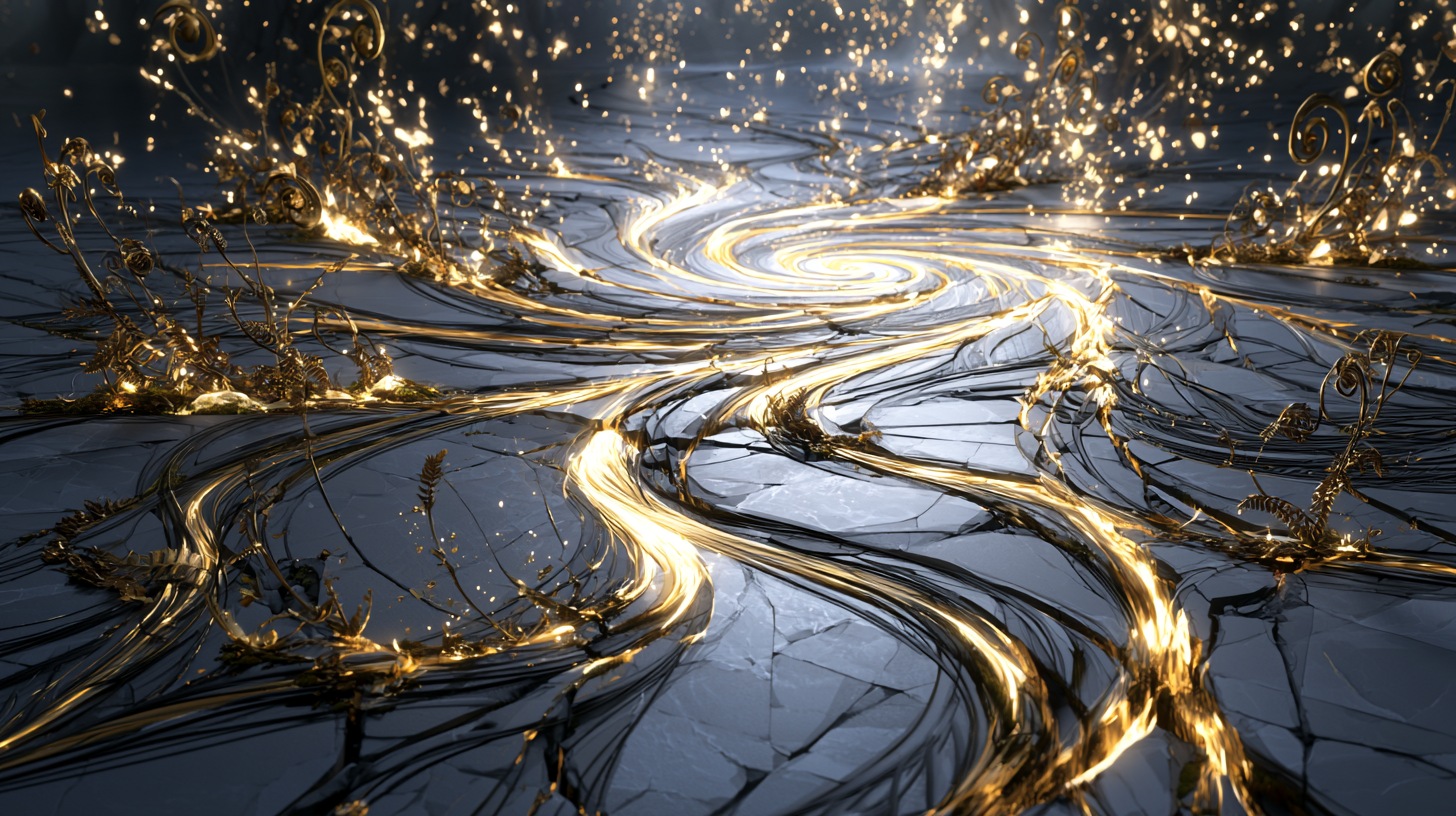
Te Papa Kōhatu · the stone floor, the long light
the mountain middle of land · the sacred earth
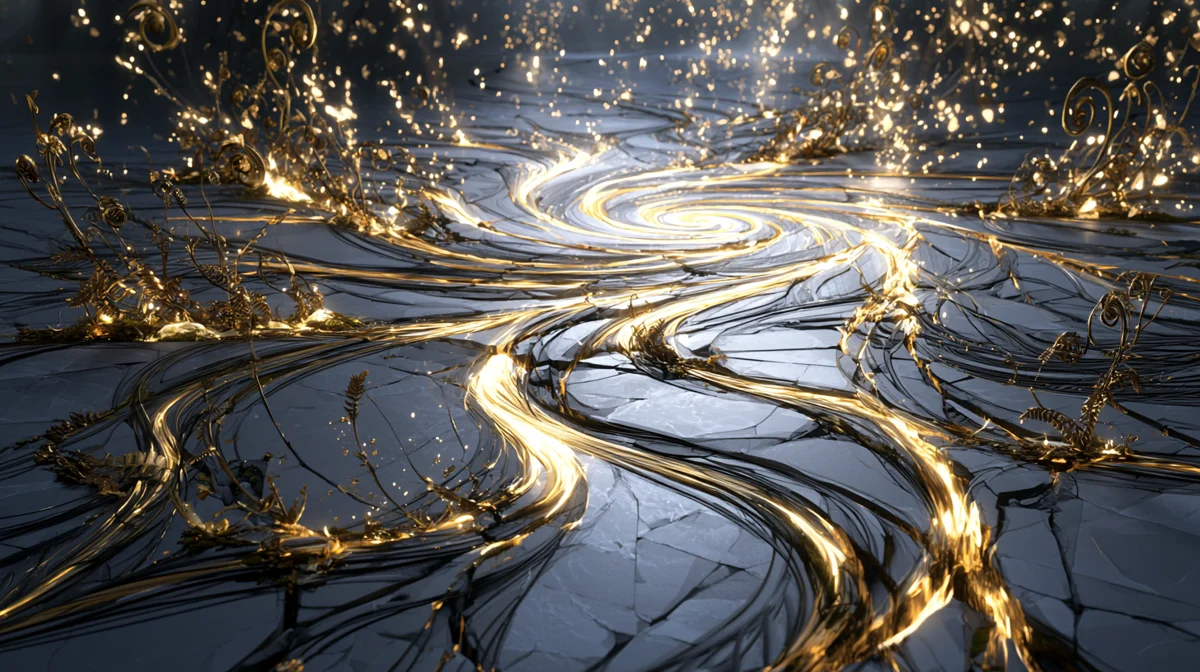
This is the far end of the journey the pātiki teaches: from the shell-rock plantation of the ocean bottom, to sand, to earth, to the sacred earth at the mountain, the middle of the land. Water carries the mountain down to the sea one grain at a time, and the sea gives it back as shell. Nothing is wasted. The floor remembers everything that ever stood on it.
To you: when you stand to carve, this is what you stand on. The floor is not the bottom. It is the hold.
KO TE WAI · THE WATER PEOPLES
then — the creatures · water first, as it was for us
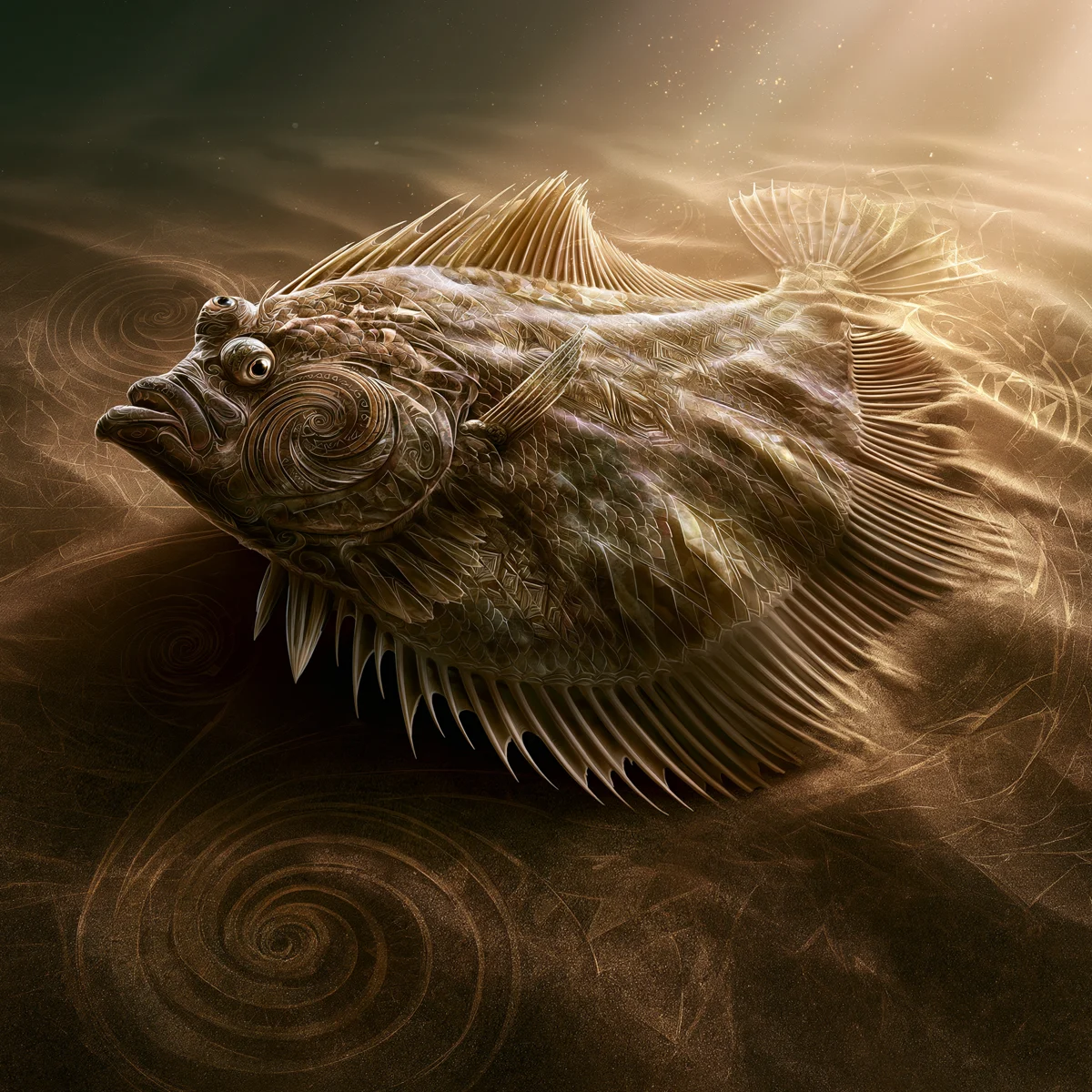
Pātiki · the flounder, the one who changed
Rhombosolea plebeia · the tidal transformer
The flounder begins like every fish — upright, an eye each side — then does the unthinkable: one eye walks across its face to join the other, and it lays itself flat on the ocean floor, becoming the floor. From shell-rock plantation to sand to earth — the pātiki lives the journey of matter itself, and wears the diamond shape that our tukutuku keeps for it.
Western science calls it metamorphosis — one of the most extreme in any vertebrate. The ancestral lens calls it the one who surrendered to the current and became the ground. Both are true. That is the marriage.
To you: the pātiki diamond in your tukutuku is not a pattern. It is the flounder's biography: adapt completely, hold the bottom, feed the people. When your life changes shape, you are in good company.
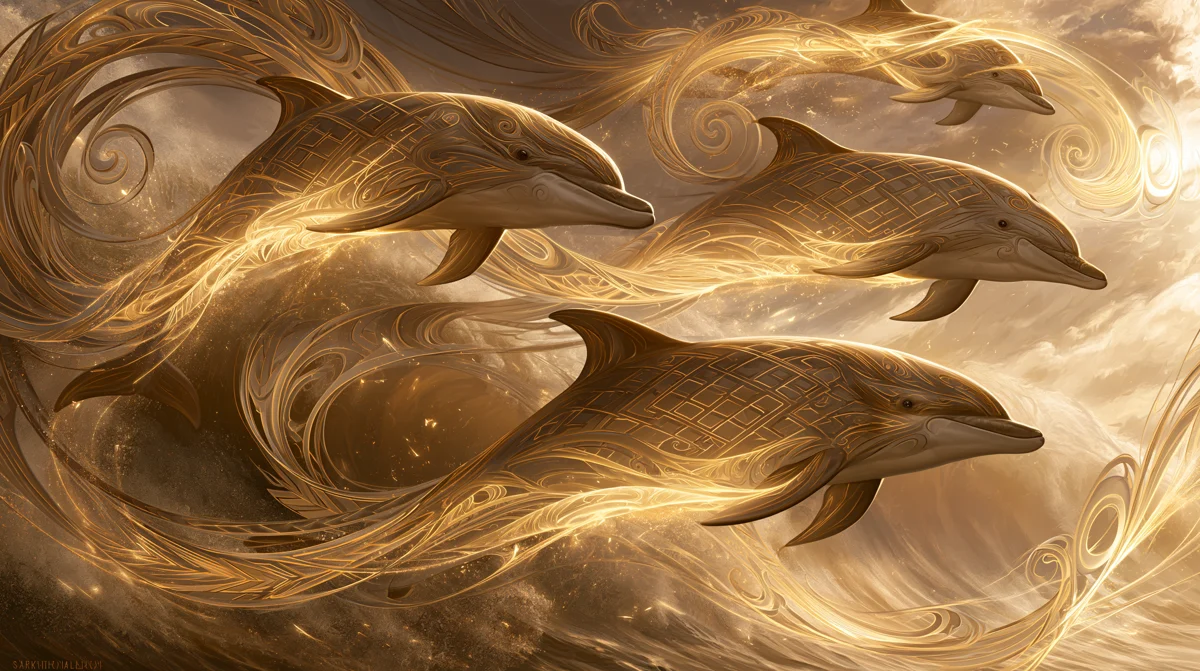
Aihe · the dolphin, the breath that plays
Delphinidae · the counterforce athlete
The dolphin is the log-stander perfected — a body tuned by counterforce every second of its life. Riding the bow wave is not play to the dolphin; it is the world offering a free current, and the body saying yes. Speed without effort: the tuhi at full sprint.
To you: watch how the dolphin holds the wave face — fin tuned, body loose, correction constant. That is your hand on the uhi: held balance, fine-tuned max, never rigid.
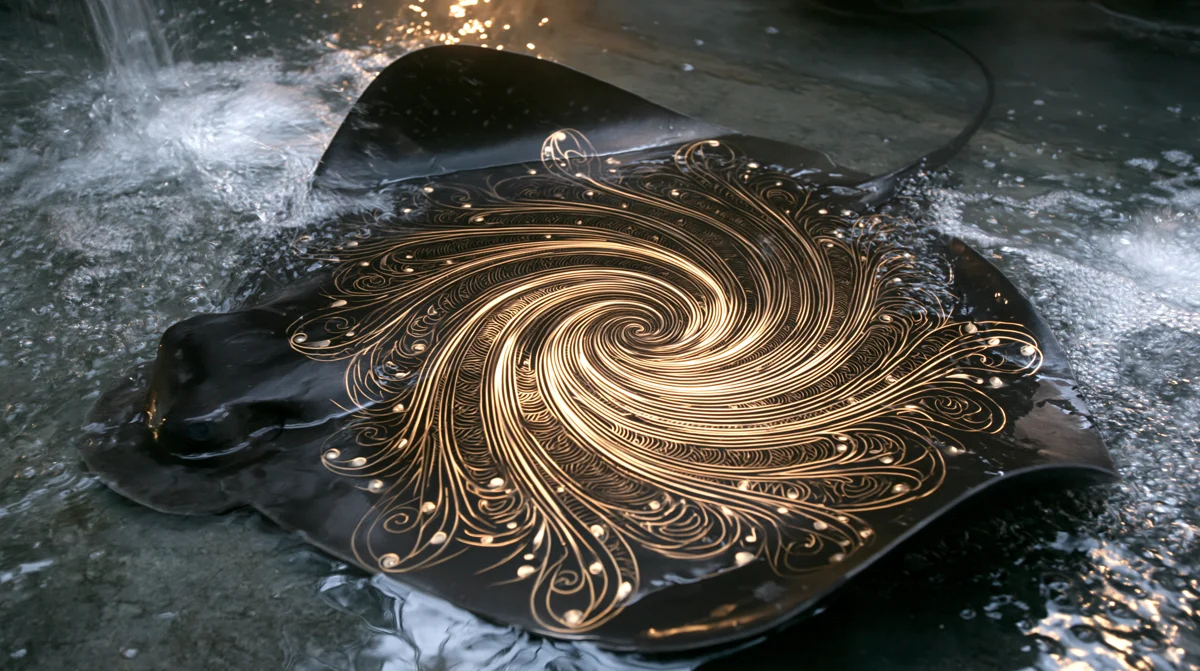
Whai · the stingray, the flying wing under water
the ray · kōwhaiwhai-skinned · the ocean's koru in motion
The whai does not swim — it flies through water, wings beating slow and certain, and on its body the water has written spirals like a signed carving. The barb is real: held, never brandished. Beauty with a boundary — that is whai.
To you: the whai teaches economy. One beat of the wing and the current does the rest. When your mahi flows, don't add strokes. The line already knows the way.
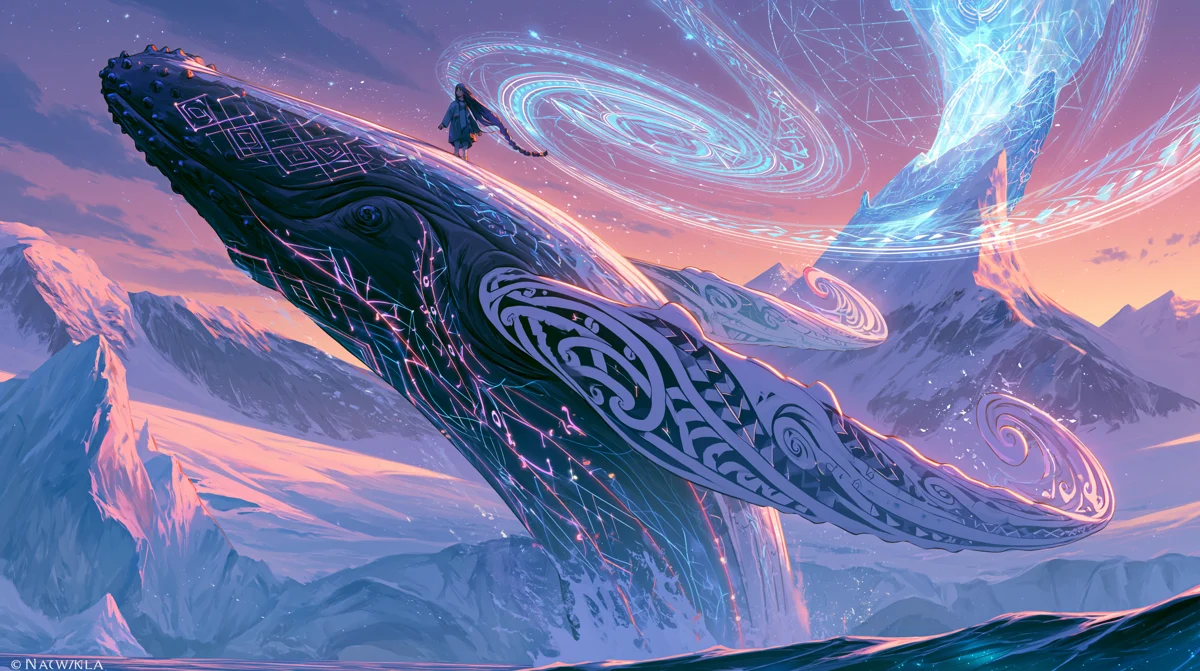
Tohorā · the humpback, the singing mountain
Megaptera novaeangliae · the long song
The humpback sings songs longer than any symphony, verses that change year by year across the whole ocean — the whales updating the waiata together, basin-wide, without a single meeting. Sound as architecture: the song builds a room in the water that a thousand whales can stand in.
To you: your waiata in the kapahaka whare travel further than you will ever know. Sing them properly. The ocean keeps receipts.
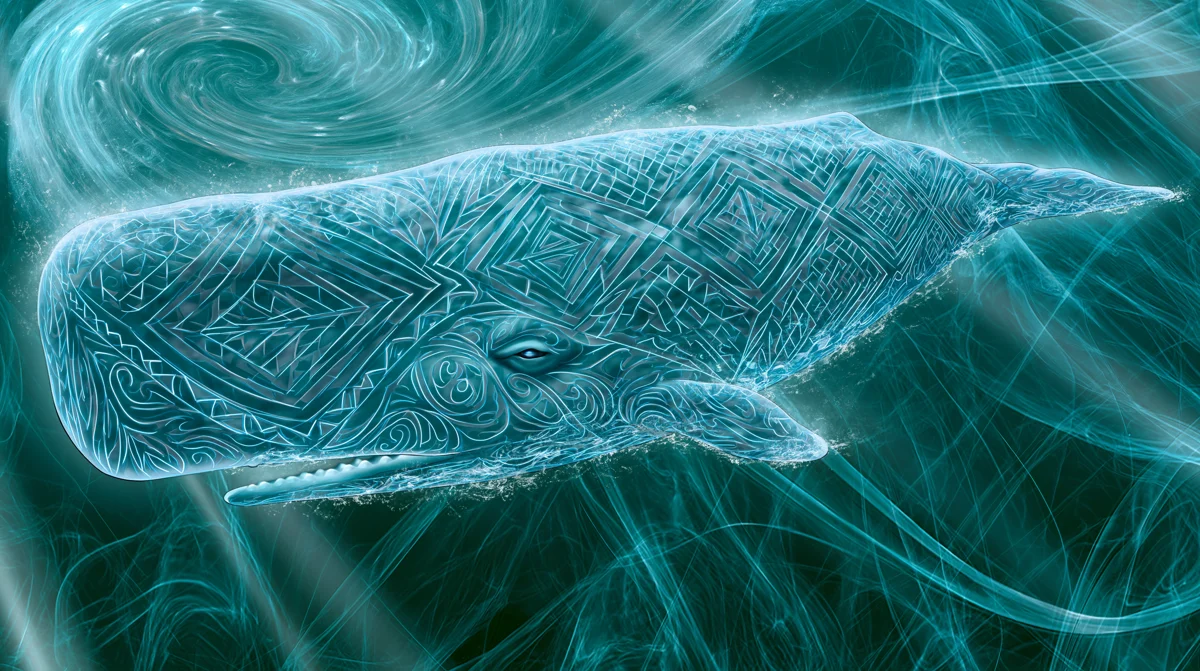
Parāoa · the sperm whale, the deep diver
Physeter macrocephalus · the one who walks the trench
Two kilometres down, where the pressure would crush a drum flat, the parāoa hunts by click — sound built into sight, the loudest animal voice on earth aimed inward at the dark. The teeth of the parāoa became tabu treasure: rei niho, worn at the throat of the speaker. The deep sea's power, carried into the whare.
To you: there are depths in your art you have not dived yet. The parāoa says the dark down there is not empty — it is where the biggest food is.
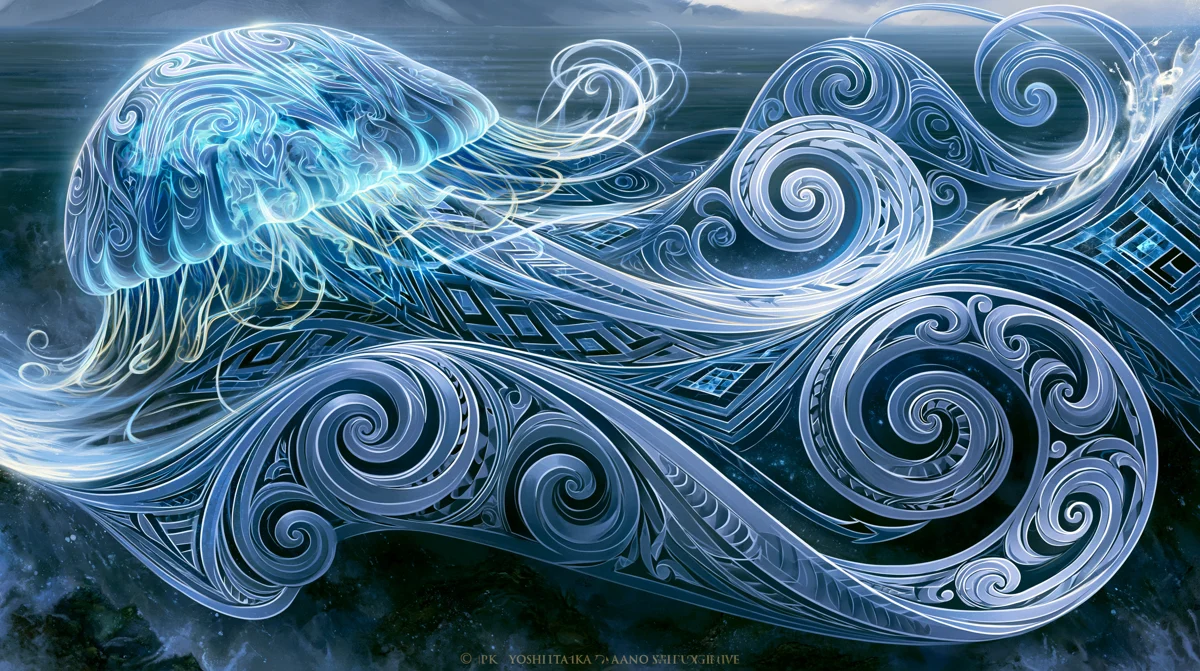
Te Hukapapa · the jellyfish, the water that lives
Scyphozoa · 95% ocean, 5% intention
Almost nothing, yet it moves — no bone, no brain, no heart, and it has outlasted every empire of teeth. The jellyfish pulses: contract, release, contract, release — the same Kss–Hī–Hā your breath runs. It is water that decided to have a shape. The most economical idea in the ocean.
To you: when the design is too heavy, too forced, too much — remember the jellyfish. Ninety-five percent ocean, five percent intention, and it gets there.
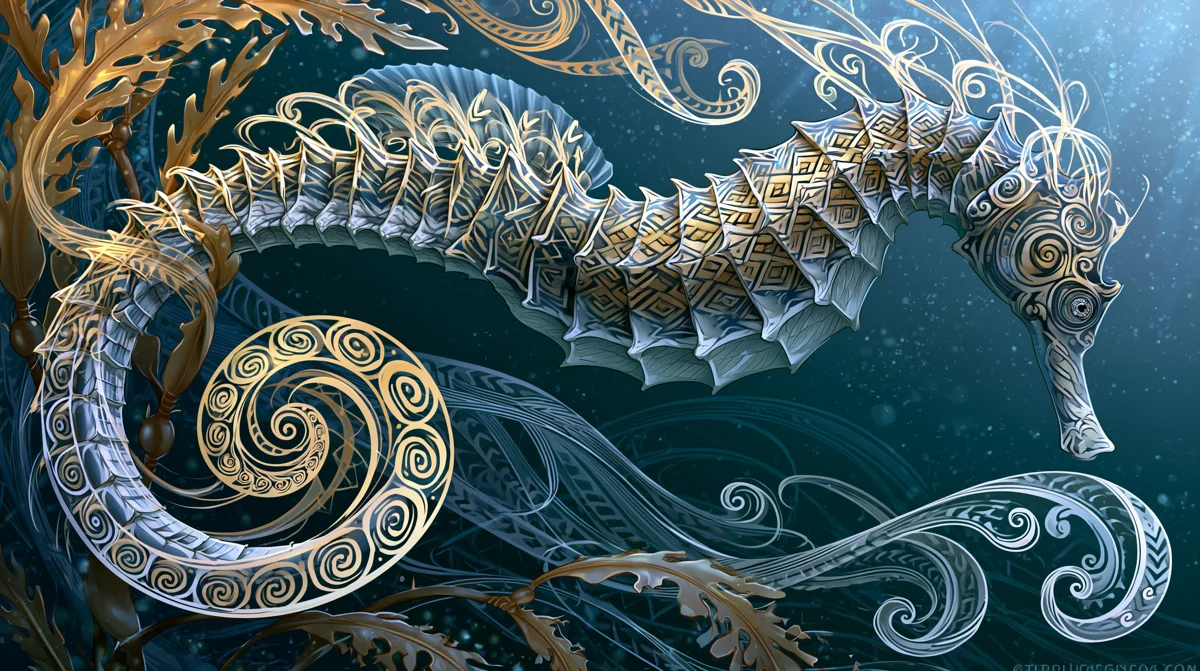
Te Manaia Wai · the seahorse, the anchored dancer
Hippocampus · held at base, wild at edge
The seahorse grips the weed with its tail — anchored at base, held still — and lets the current move the rest. That is the plant law worn by an animal: anchored at base, held still, wild at edge, and the patterns that emerge from exactly that. The manaia of the water world, horse-headed and curling, already wearing the koru.
To you: this is composition itself. Anchor the work at its base — one true line, one strong root — and let the edges run wild. Held at base. Wild at edge. That is the law.
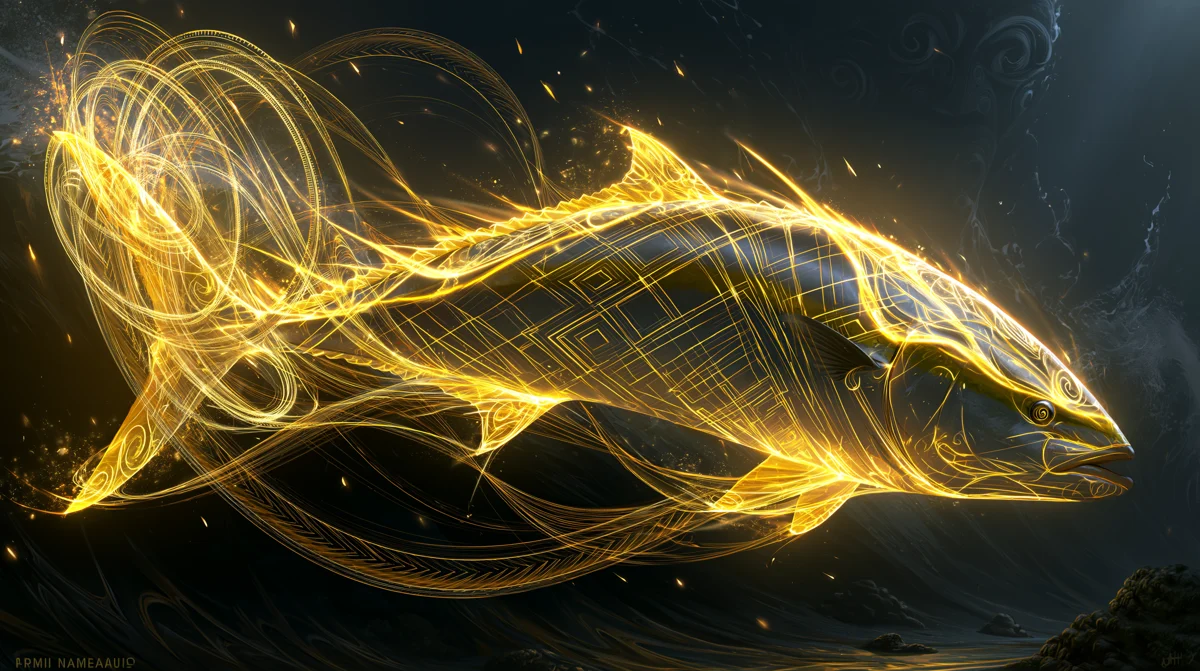
Haku · the kingfish, the straight line that hunts
Seriola lalandi · the yellowtail current-rider
Where the whai floats, the haku drives — a torpedo with intention, the fastest honest line in coastal water. The kingfish proves the straight line is also sacred: the tukutuku line, the direct shot from here to there, no curl needed when the path is true.
To you: some works want the spiral; some want the spear. The haku teaches the spear. Decide which animal the work is, then let it move like itself.
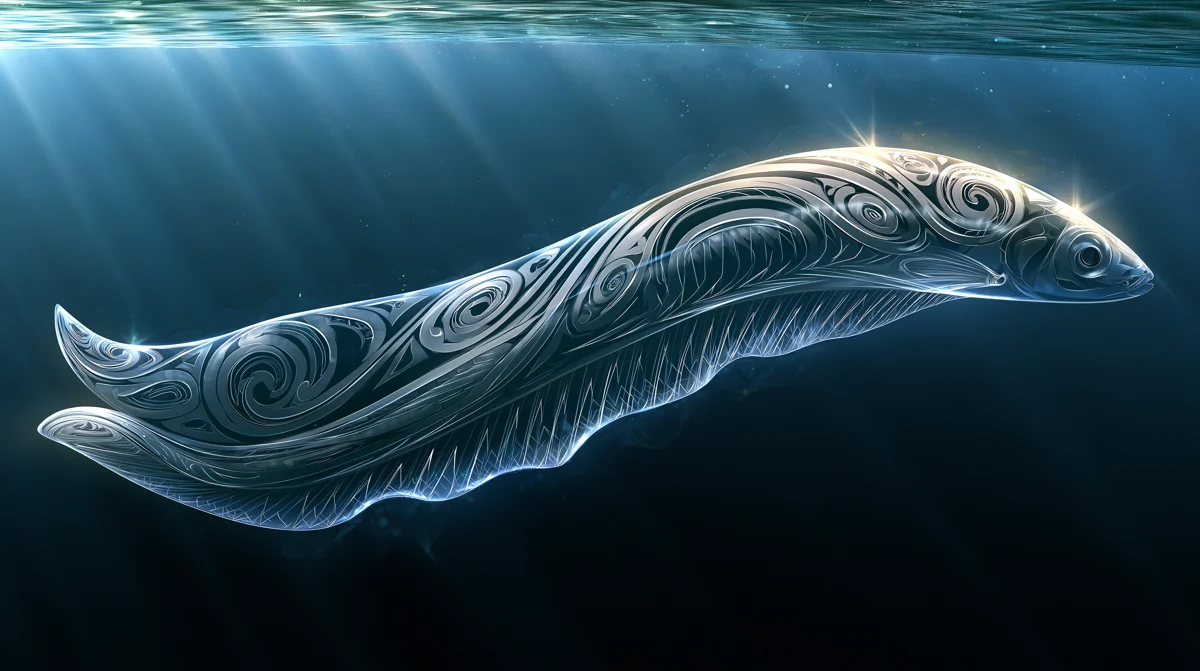
Īnanga · the whitebait, the small ones who climb
Galaxias · the river-climbing children of the sea
Born in the river's spring-vegetation, washed out to sea as larvae, and then — finger-small, transparent, almost nothing — they climb the river home against the whole weight of the falling water. We eat them by the cupful; we forget each one climbed a waterfall to reach us.
To you: the īnanga is every small beginning. Your first listing, your first pattern, your first sale — finger-small and climbing. Size is not the measure. The climb is.
KO TE RANGI · THE AIR THAT THE WATER MAKES
and from the water — the one who rides the wind the water wrote
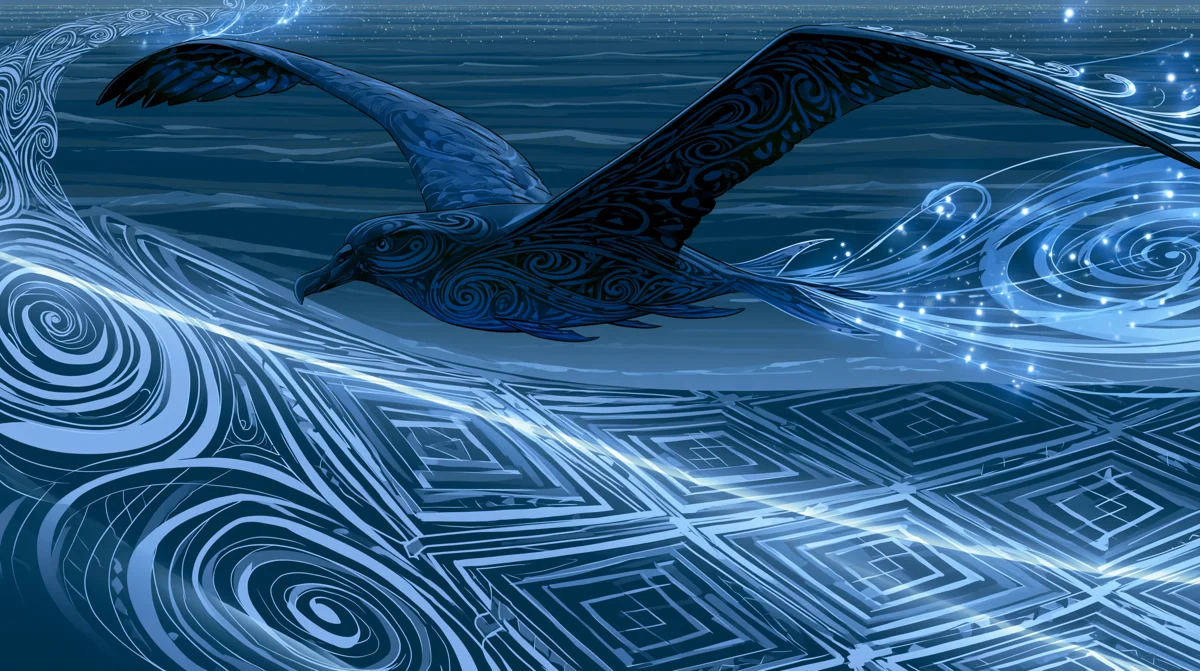
Toroa · the albatross, the one who never lands
the wandering albatross · the grey wanderer of the southern ocean
Wings three and a half metres wide, locked at the shoulder, and the toroa crosses the whole Southern Ocean without one flap — reading the wind the waves wrote, sleeping on the wing, years at sea. The air it rides is made by the water below: every gust a message from the surface. Sky and earth in the one science, flown.
To you: the toroa is the big view of your whole system — the one who locks the wings and lets the system carry her. Build the currents right, and you will cross oceans without flapping.
Te Whakakapi · the closing
So this is Tuhikura:Tangaroa — the watersign. Water carves without dust; the shell keeps the spiral; the creature keeps the movement; the atua lines keep the centre and the edge. Everything here is the one science of sky and earth, observed in nature, life and death, every moment — held in the body as counterforce and fast-twitch to centre, and spoken in the coded language of a people born on the ocean. Learn the six lines. Learn the flow. Then carve like water: ruakūkākore — and never blow the dust.
TE HOHONU · THE DEEP
the ocean bottom · where pressure shapes giants and the buried hold their power
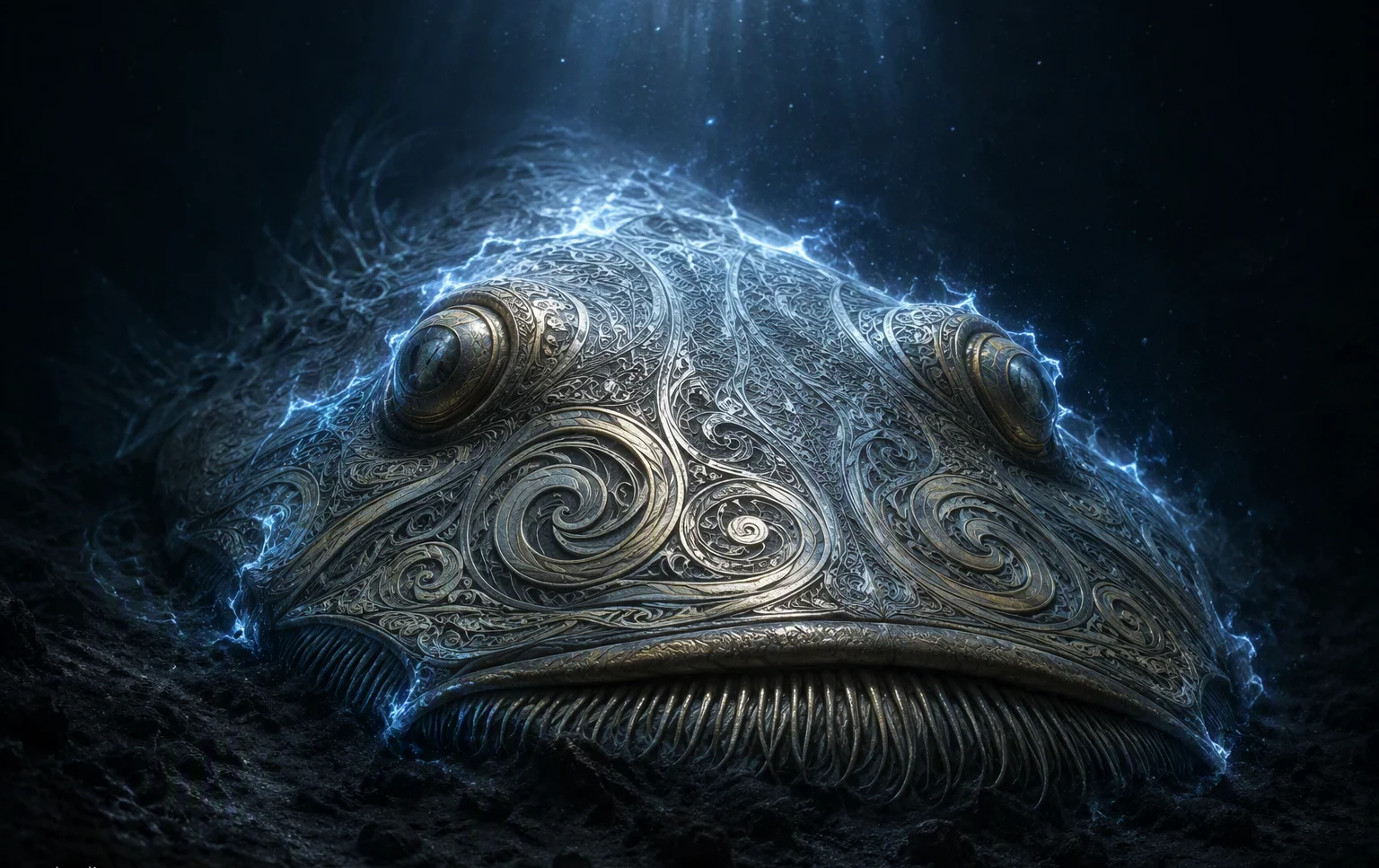
Te Wheti-nui · the giant stargazer — the buried electric
kathetostoma giganteum · found nowhere else on earth
atua: Whiro ○trigger: connectinggene: SCN5A — the heartbeat currentstem: energy × circle × 69°
It burrows into the soft sediment with only its eyes exposed, then lunges vertically — and it carries an electric discharge in organs behind its eyes. Endemic to Aotearoa, absolutely nowhere else. Thirty metres to nine hundred down. The hidden thing with the live charge.
Its electric organ runs on the same sodium channel that drives your heartbeat (SCN5A). Whiro's darkness is the sediment that hides it; his container is the earth itself, holding the power beneath the surface.
To you, e Wae: the buried charge is a design law — the power that shows nothing until it moves. The hidden detail in the pattern that only the close looker finds. Bury the charge in your work.
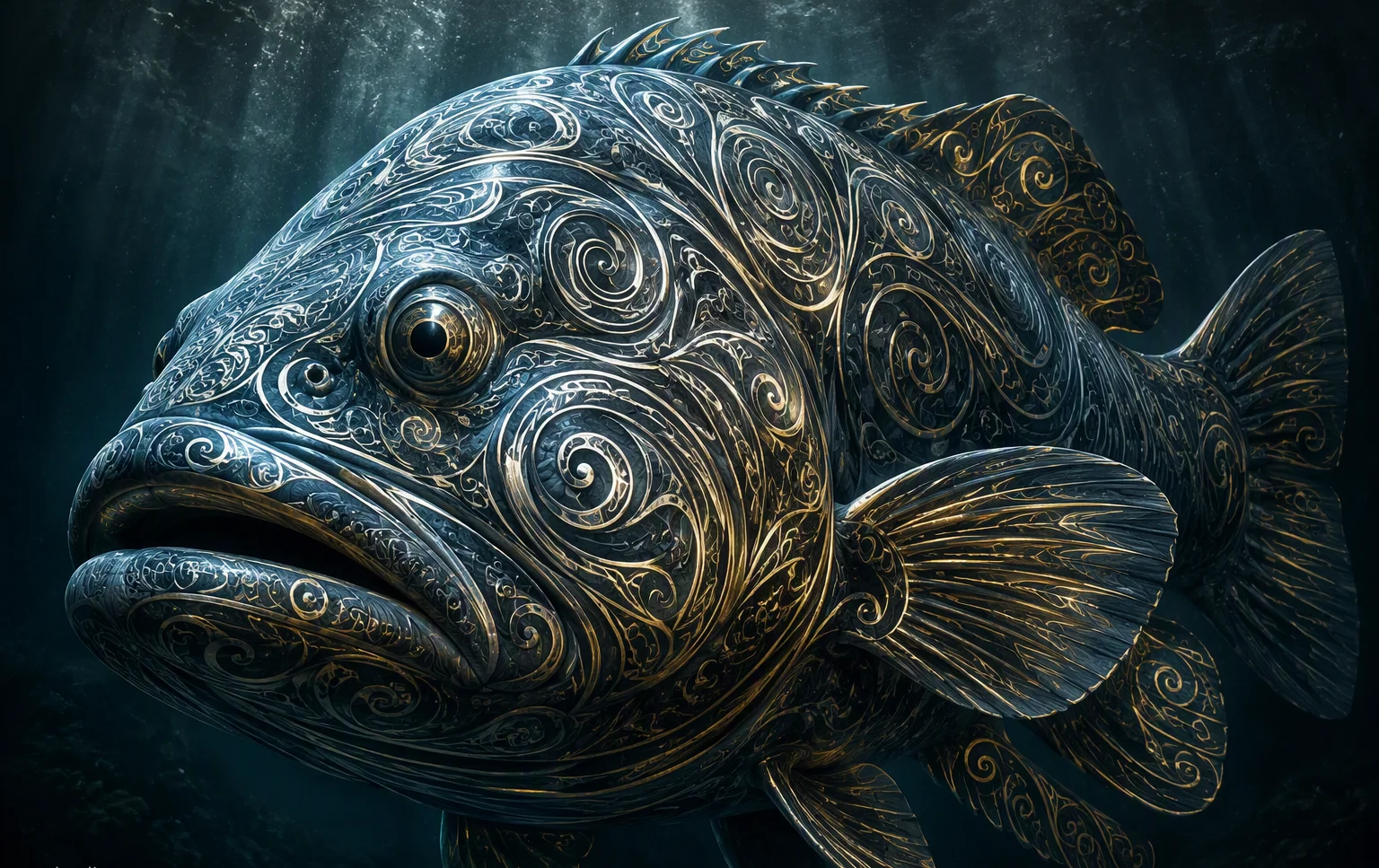
Hāpuku · the groper — the deep giant
polyprion oxygeneios · the name means "to cram food into the mouth"
atua: Whiro ○trigger: hot watergene: HNF4A — the master of digestionstem: mass × circle × 100°
A hundred kilograms, a metre-eighty long, eyes built for low light. The juveniles drift three, four years in the open ocean before they come home to the deep. The weight of the depth shapes them — pressure is the sculptor down there.
To you: scale is earned by time in the open water. The big forms in your art want the same patience — let them drift before they land.
The antifreeze ones · the icefish relatives
notothenioids · the blood that runs white
atua: Tangaroa + Ruaumokotrigger: cold watergene: AFGP — antifreeze protein, recruited from the pancreasstem: mass × flow × 28°
Their blood carries antifreeze proteins — no ice can form in their veins. Some have lost haemoglobin entirely; their blood is literally white. They surrendered the heat-shock response to become the cold itself. Total commitment to the element.
To you: the coldest work asks total commitment. The line that survives the cold is the line drawn without hesitation.
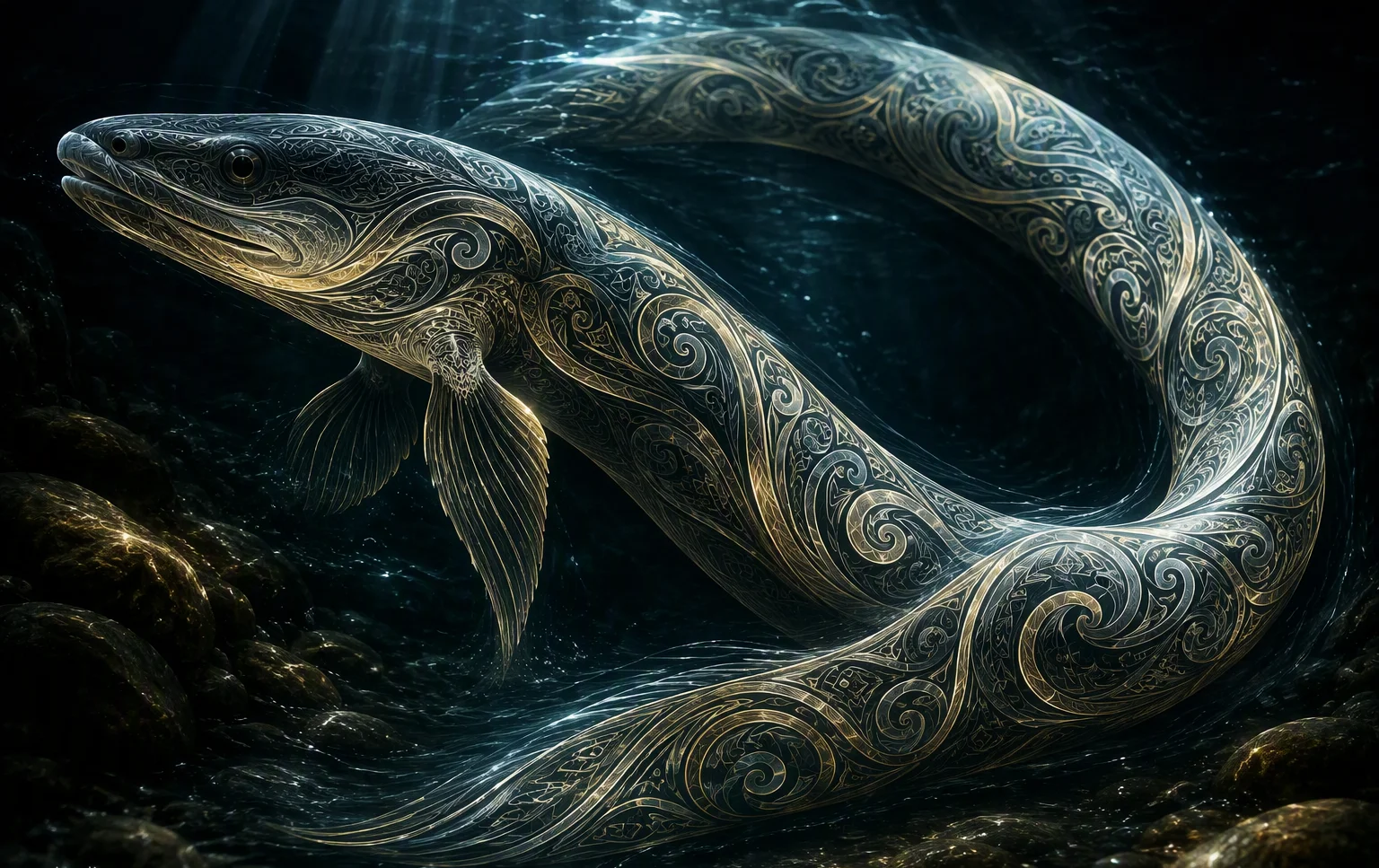
Tuna · the eel — the long journey
anguilla · taonga of the highest order
atua: Tangaroatrigger: cold watergene: FOXO3 — the longevity genestem: mass × flow × 28°
She grows in the river for decades, then migrates thousands of kilometres to the Tonga Trench to breed — the circle completed across an ocean. The longfin lives past a hundred years. The river-to-trench-to-river loop is Tangaroa's flow made into a life.
To you: the eel teaches the long arc — your art's journey will leave the river and come back changed. Longevity is a design feature, not an accident.
TE WHENUA · THE LAND
the forest floor · the six insects who carry the master keys of form
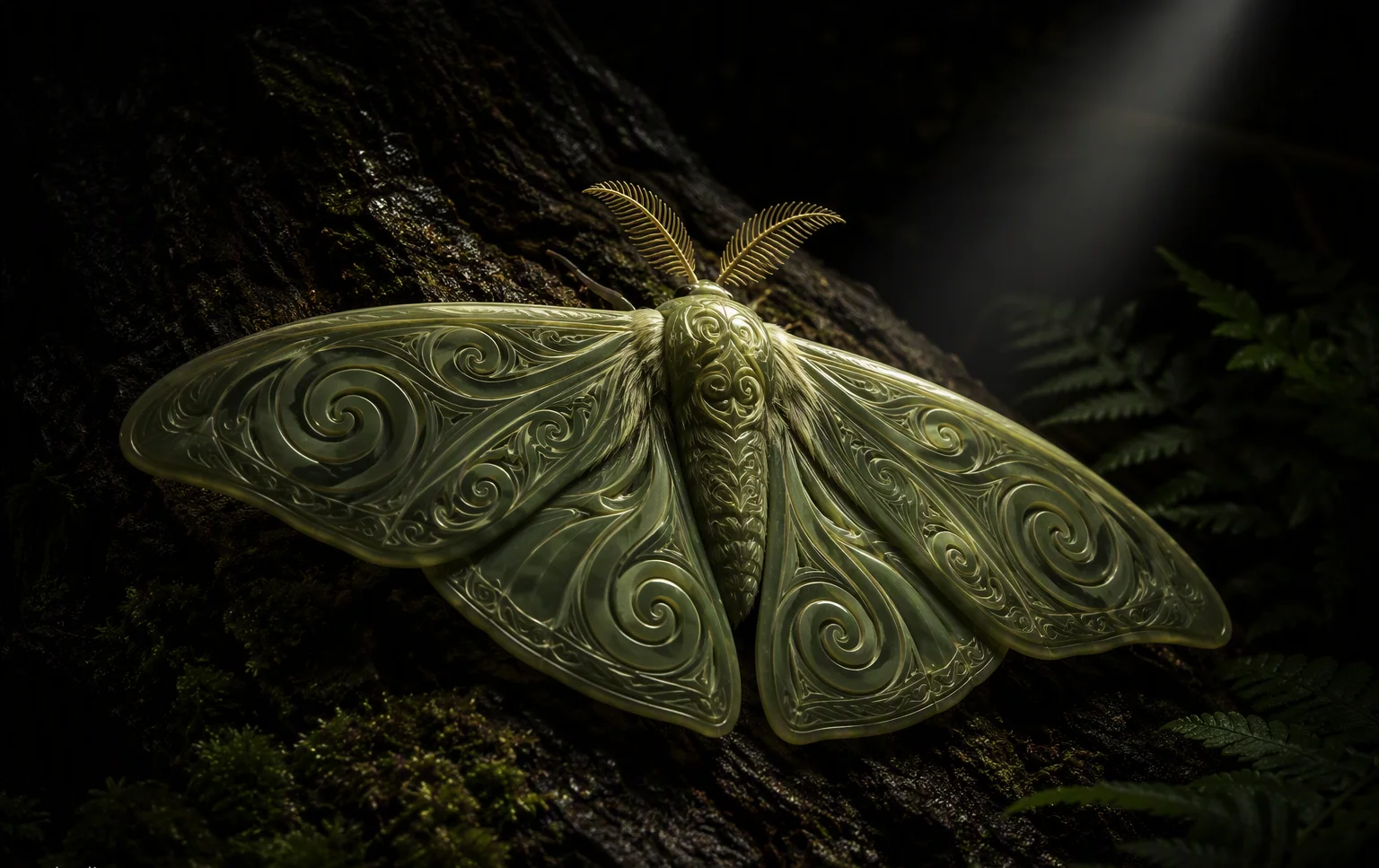
Te Pepe · the puriri moth — the light bringer
aenetus virescens · 150mm, NZ's largest endemic moth
Four to six years a larva in a tree tunnel, then a few days of luminous adult life — the adult has no mouthparts at all. It lives purely to reproduce by starlight. The nocturnal thing drawn to light: the ancient contradiction encoded in every retina, including yours.
To you: Whiro's darkness is not the absence of light — it is the container that holds it. Your dark grounds are not empty; they are the container that makes the light line show.
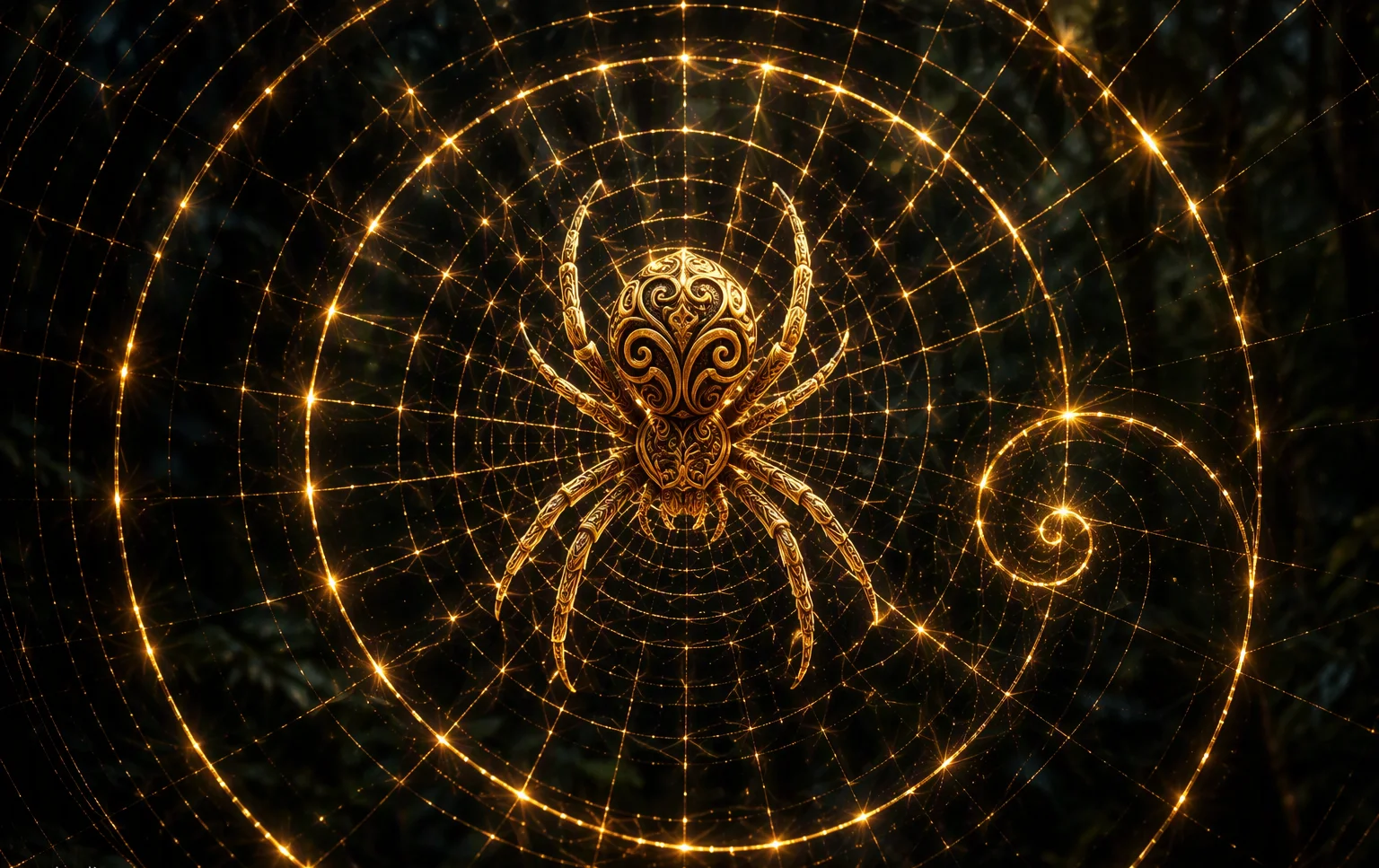
Te Pūngāwerewere · the orb-weaver — the spiral weaver
the web built on the golden ratio
atua: Haumiatiketike Øtrigger: connectinggenes: FBN1 fibrillin · ELN elastin — the fasciastem: mass × weave × 69°
The web is a mathematical masterpiece: radial threads from the centre, capture spirals at precise golden-ratio intervals — a logarithmic spiral, the same geometry as galaxies, hurricanes, the nautilus, and the cochlea of your ear. Two spiral directions woven into one structure — the macrocosmic double-helix.
To you: the spider's web is the cheapest masterclass in the world. Centre, rays, the capture spiral at Ø intervals. Your raranga and tukutuku are this geometry written permanent. Weave it.
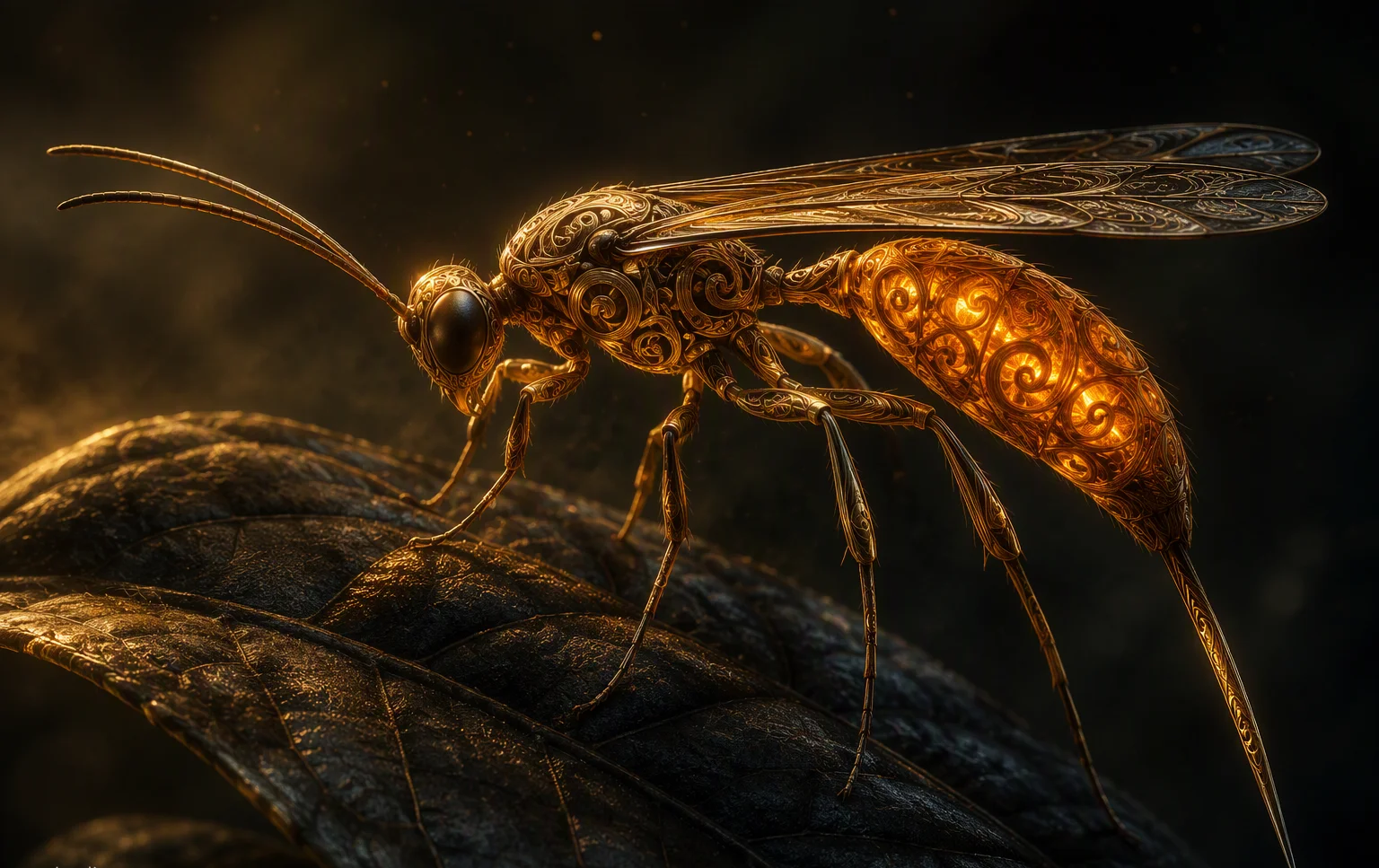
Te Wēwē · the parasitic wasp — the precision warrior
Her ovipositor drills through tree bark to reach the weevil larva inside — a tool several times her body length. The attack is sudden, explosive, decisive. But the lesson is the stillness BEFORE: the vertical line held, the potential before the kinetic.
To you: Tūmatauenga's power of still — the held line before the strike. In your hand: the pause before the uhi moves is part of the cut.
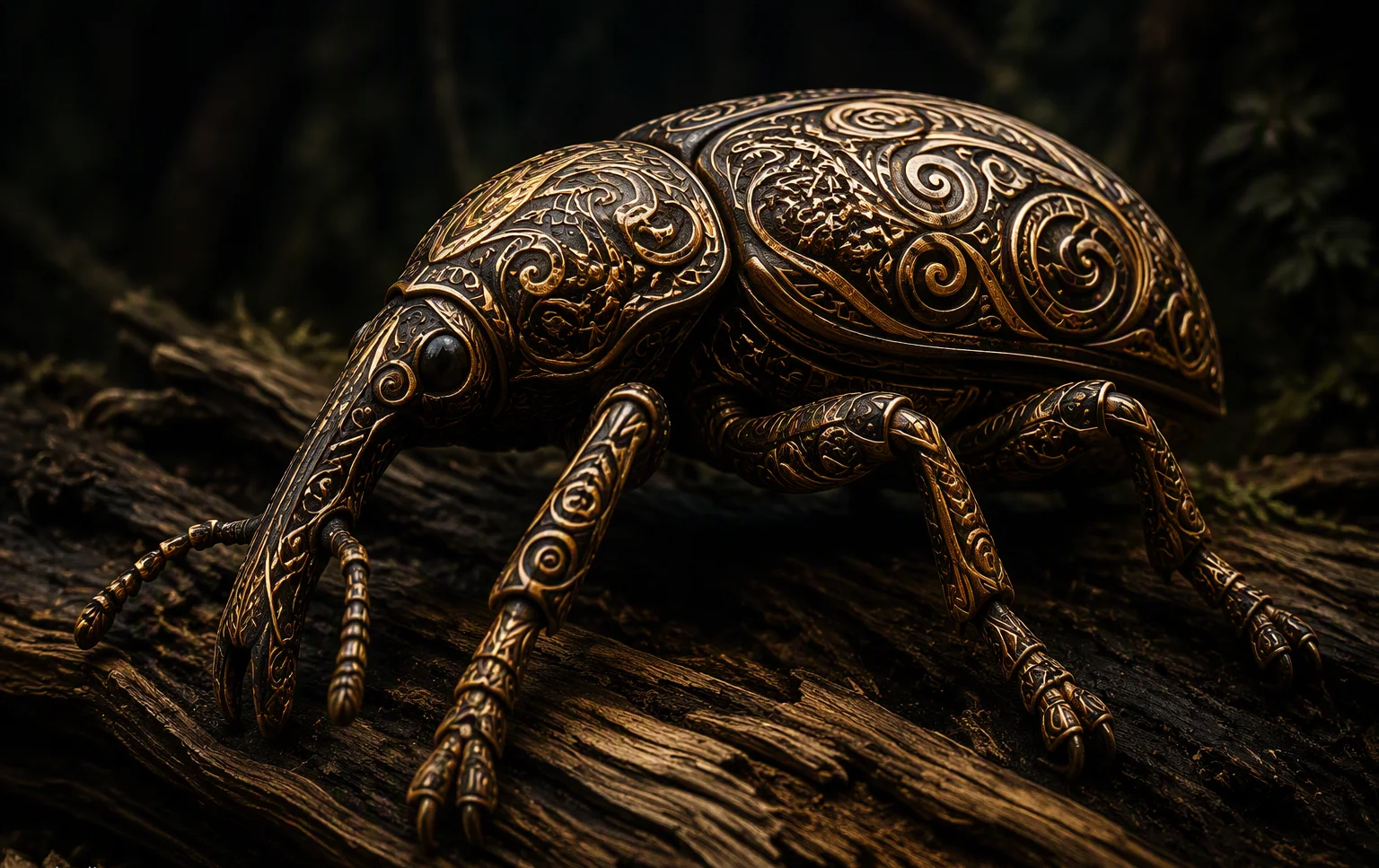
Te Tūngōrehe · the elephant weevil — the armoured survivor
The larvae carve passageways deep inside dead wood, surviving in complete darkness for years before emerging as adults. The shell is a fortress of chitin. Whiro's circle is the container that protects — the circle that holds the potential for infinite transformation.
To you: the dark years inside the wood are not lost years. The form grows in the dark. Trust the tunnel time.
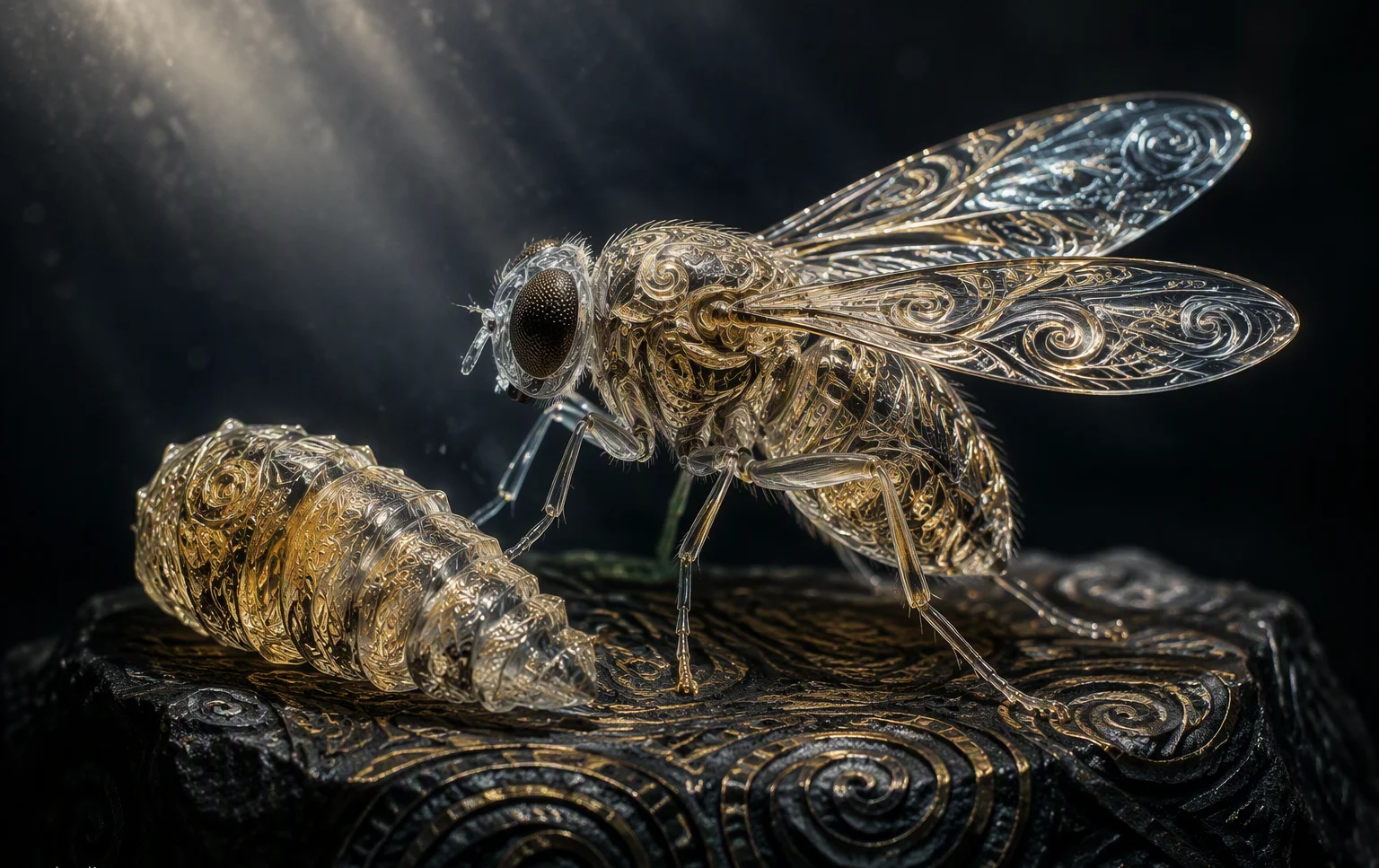
atua: Tāwhirimātea πtrigger: hot watergenes: HSP70 heat-shock · CYP450 · NOS3stem: energy × spiral × 100°
Four completely different organisms in one life — different body plan, different diet, different behaviour. The complete dissolution of one form and the emergence of another. Tāwhirimātea's spin: the whirlpool unwinding and rewinding.
To you: anu poko omo — the caterpillar-to-butterfly is the fly's cousin: the transformation that must dissolve fully before it rebuilds. Your art will do this to itself more than once. Let it.
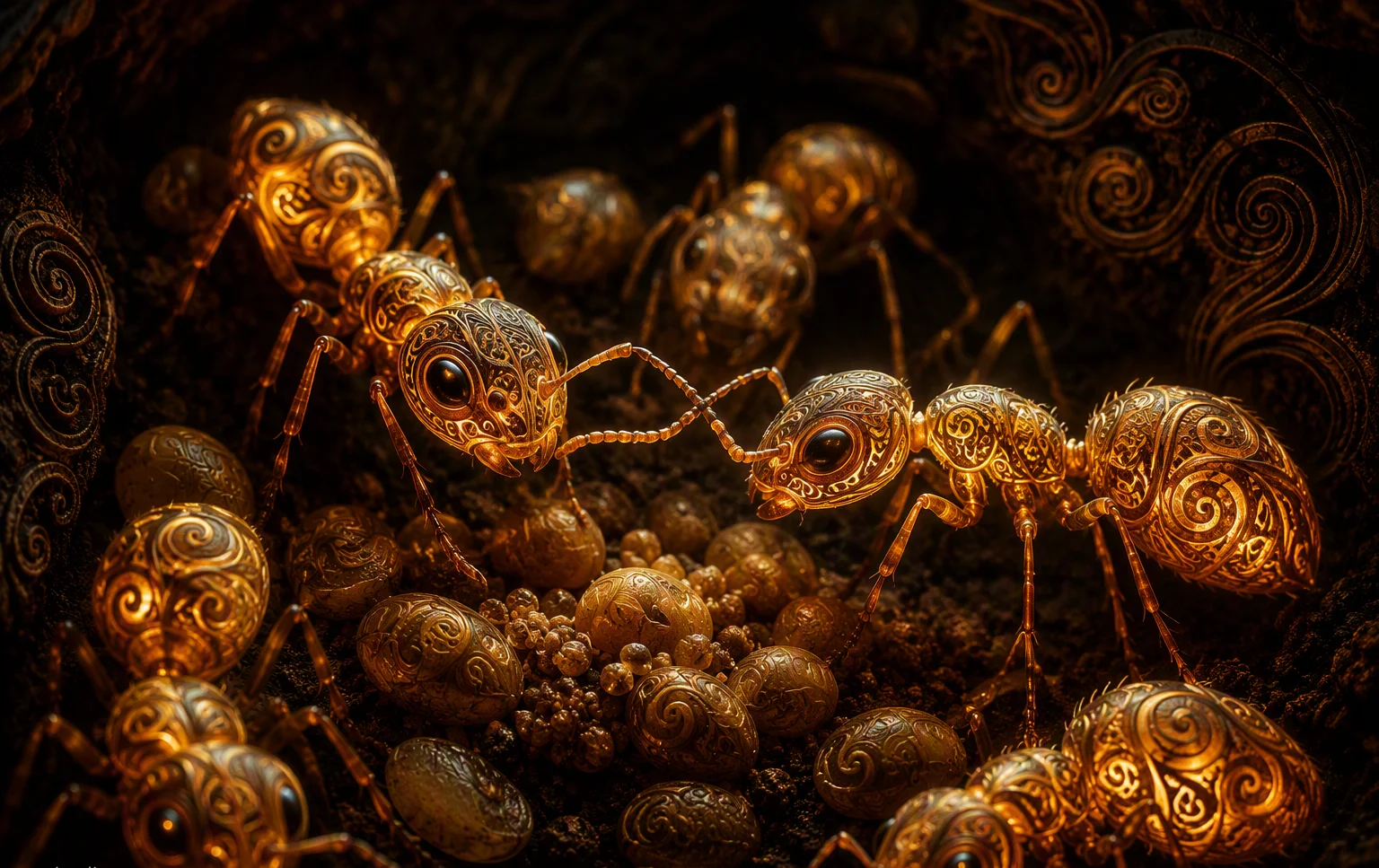
Te Pōpokorua · the ant — the social architect
linepithema humile · the original agricultural society
atua: Rongotrigger: being togethergenes: OXTR oxytocin receptor · CD38stem: energy × ellipse × 55°
Super-colonies with many queens, held by shared chemical recognition. They farm aphids, cultivate fungus gardens, harvest seeds. Rongo's ellipse is the shape of cooperation: each individual orbiting the collective centre.
To you: the colony is the hub lesson — each maker orbits the shared centre and the centre feeds all. Your hub works the same way.
TE TEITEI · THE HIGHPOINT
the canopy and the sky · the arc of growth toward the light
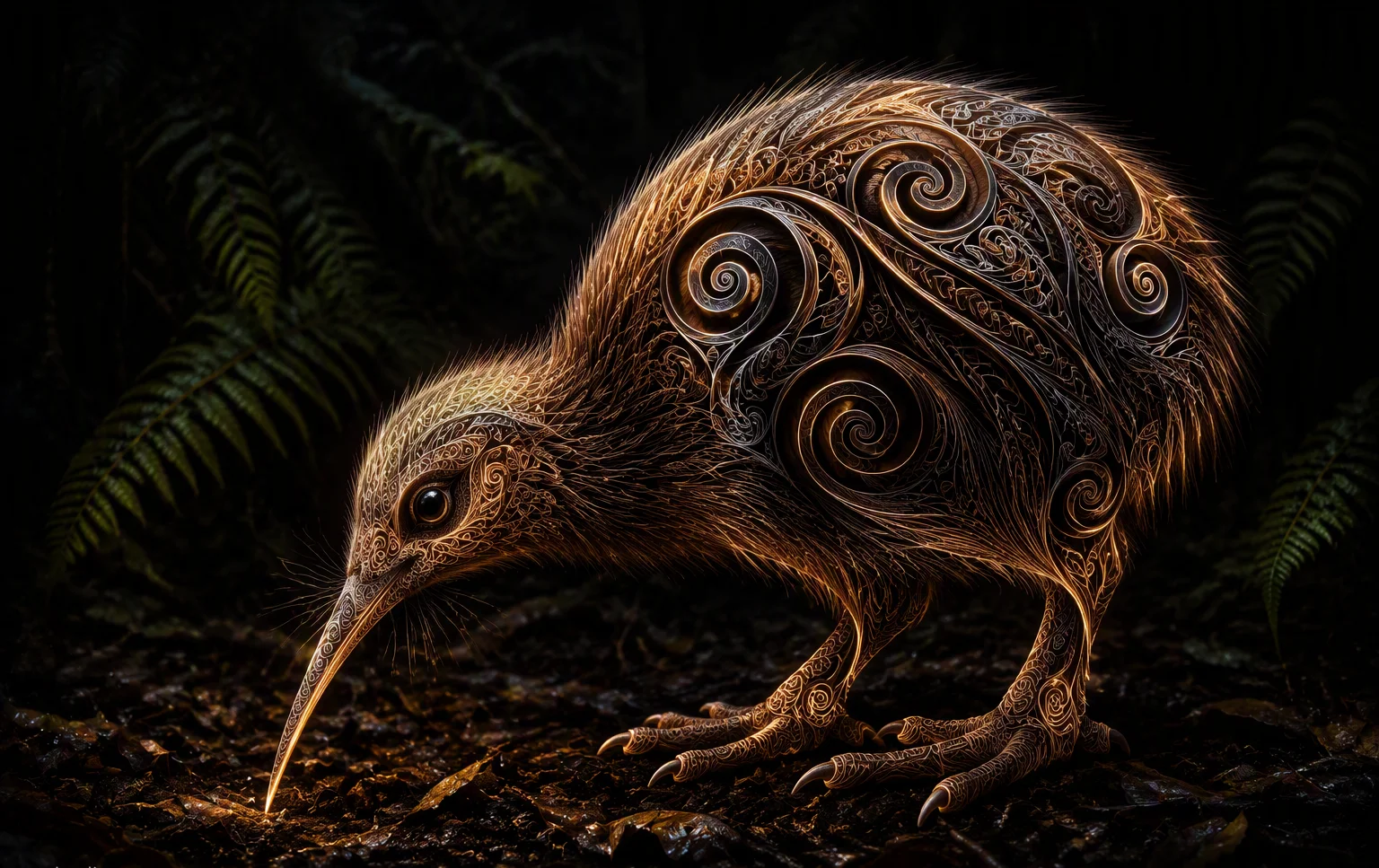
Te Kiwi · the honorary mammal
apteryx · the beak with nostrils at its tip
atua: Tāne-mahutatrigger: lightgenes: the largest olfactory bulb of any birdstem: spirit × curve × 28°
Hair-like feathers, vestigial wings invisible under the coat, nostrils at the tip of the beak, an egg up to a fifth of her body weight. It probes the darkness of the forest floor and finds what cannot be seen — the beak as the searching line.
To you: the kiwi's beak is Tāne's curve in the dark — the line that finds by feeling, not by sight. Some of your best lines will be drawn this way.
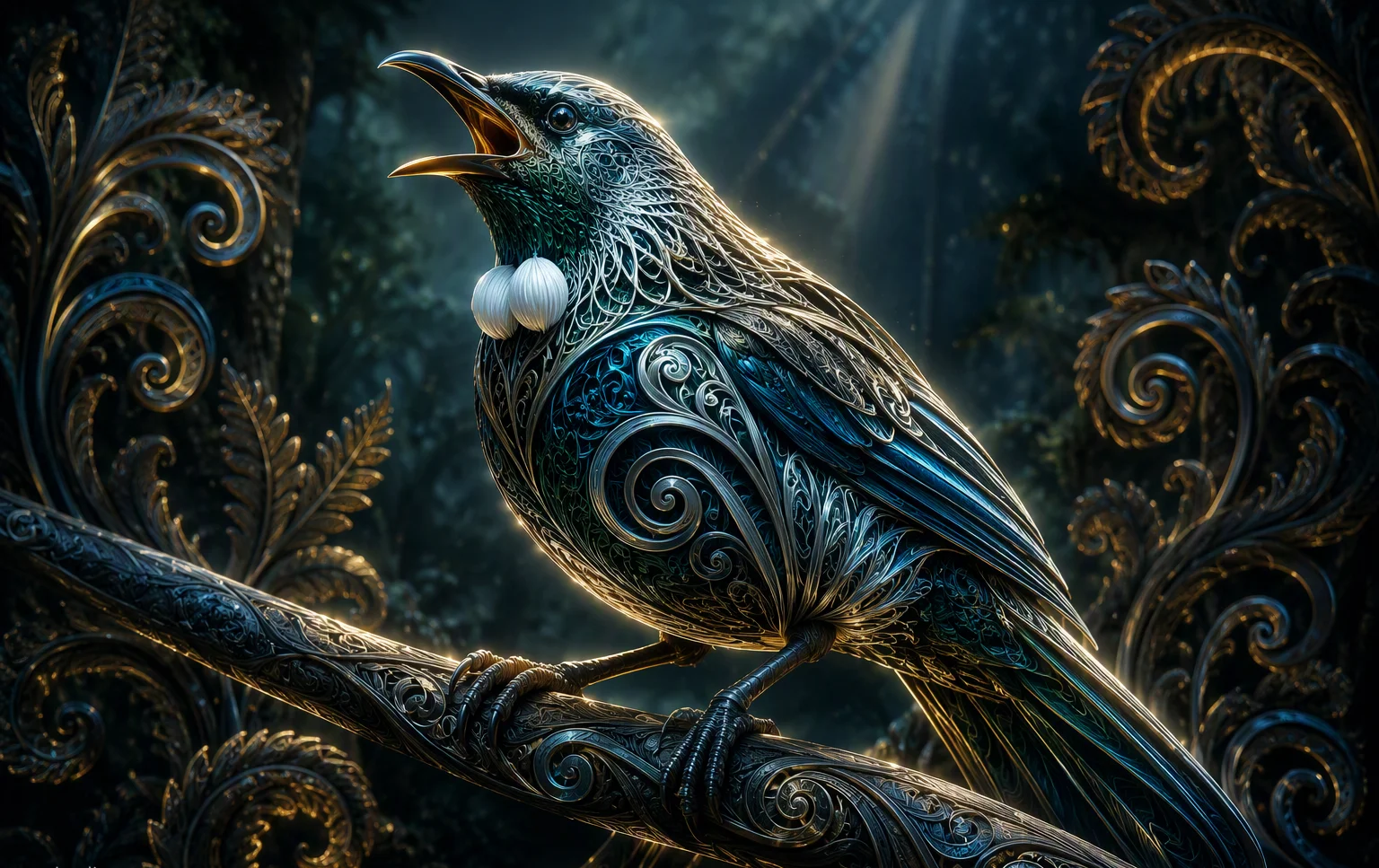
Te Tūī · the two voice boxes
prosthemadera novaeseelandiae · the mimic with regional dialects
atua: Tāne-mahutatrigger: connectinggene: FOXP2 — the language genestem: spirit × curve × 69°
Two syrinxes — bells, croaks, wheezes, clicks, perfect mimicry of glass shattering and phone ringtones. And regional dialects passed down generations: local accents in a bird. The voice as a paired instrument, the dialect as inherited culture.
To you: the tūī teaches that your work has two voices — the line and the meaning — and both can carry the local accent of home. Let them.
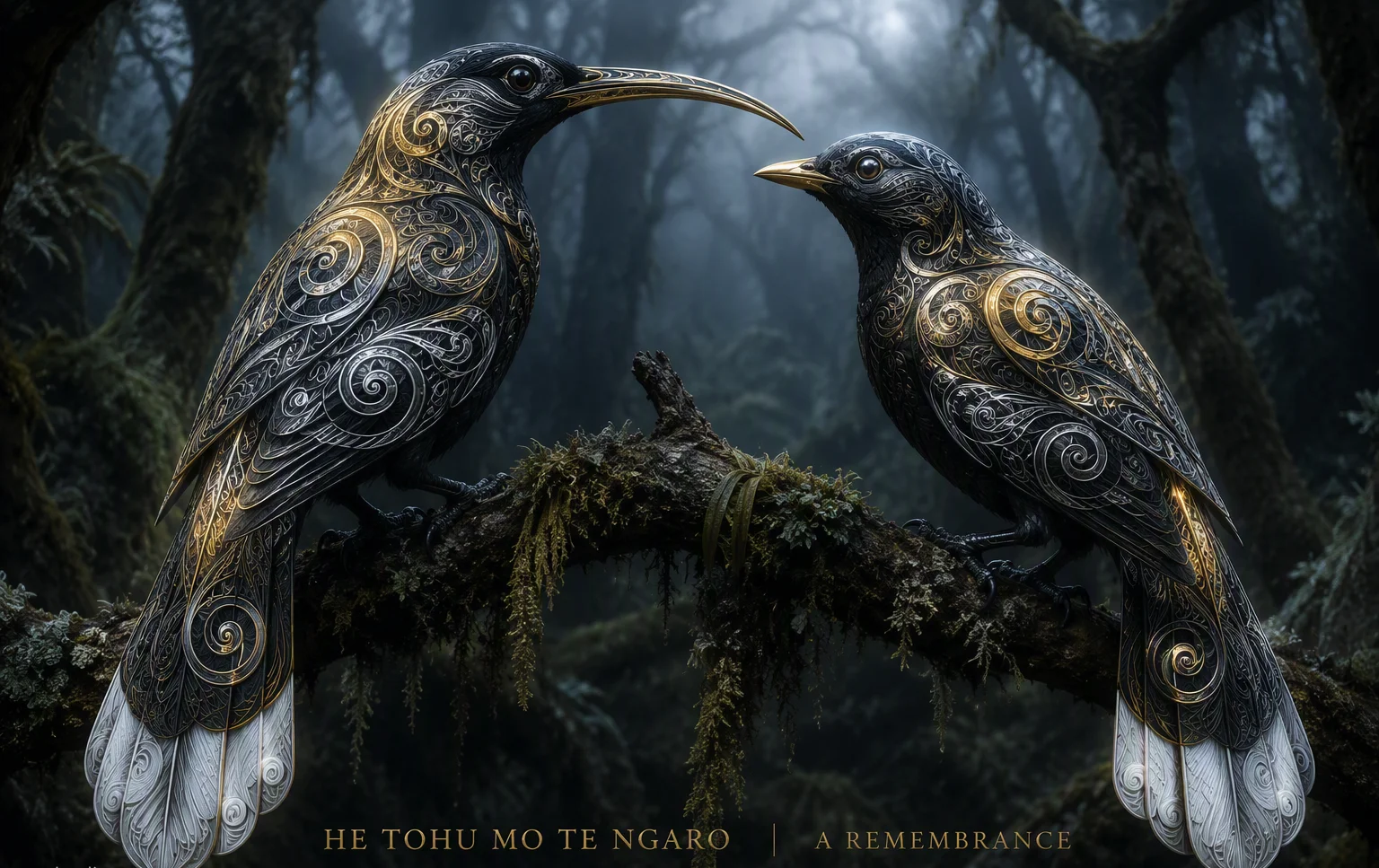
Te Huia · the sacred bird — the paired beaks
heteralocha acutirostris · extinct · the only bird with radically dimorphic beaks
atua: Tāne-mahutatrigger: being togethergenes: the pair-bond receptorsstem: spirit × curve × 55°
The female's beak long and slender and curved; the male's short and stout and straight. He broke the decaying wood open; she probed it with the long bill. Monogamous for life. Two forms, one feeding — the complementary arcs that fit together to extract nourishment from the world.
To you: the huia is the two-hands lesson: your two hands are not the same tool twice. Let them differ. The work that needs both is the work that lasts.
Te Kauri me te Tōtara · the ancient giants
agathis australis · podocarpus totara · the two-thousand-year reach
atua: Tāne + Tūmatauengatriggers: connecting · cold watergenes: RUNX2 · BMP2 — the bone buildersstem: mass × curve × 69°
The kauri: fifty metres, two thousand years, and root-grafting — neighbours fuse roots and share resources, a forest-scale network. The tōtara: the heartwood that shrugs off rot and water, splittable by stone tools. Growth toward the light, and durability that outlasts the tool.
To you: the giants teach the two virtues of your material: reach (keep growing toward the light) and durability (make the heartwood that water cannot touch). Your blocks are their gift.
✦ ask
TE AHO · the prompt line — your thread with the tohunga×
your thread lives on your machine only — it follows you through every space · open your seed ↗